Research Article | | Peer-Reviewed

The Absolute Age First Determination of the 3rd Terrace Deposits from Transilvania, Using Optically Stimulated Luminescence Method

Received: 14 August 2024     Accepted: 12 September 2024     Published: 26 September 2024
Views:       Downloads:
Abstract

For determining the absolute age of the terrace deposits, a geomorphosite located on the left side of Someşul Mare river, southeast of Rebrişoara was selected, which includes a fragment of the tread of the 3rd terrace (20-21 m relative altitude) and the cuesta slope, facing north the Făgetului Hills. The question regarding the age of fluvial terraces has been long debated in Romanian geomorphological literature age since the beginning of the 20th century. Many geomorphologists have carried out studies wherein the question of the age of the terraces, both inside the Carpathian curvature and outside, was raised. Most of the studies carried out for the terraces on the rivers of the Transylvanian Basin indicated the age of the 3rd terrace as Wurmian. Until recently, most assumptions related to the age of the terraces were based on the correlation between terraces and/or by dating the paleontological fossils discovered in the terrace deposits. Recent studies, on the other hand, use high-precision methods to determine the ages of terrace formations. Researchers, use methods like the Infrared-stimulated luminescence dating (IRSL) and SAR-OSL (Optically Stimulated Luminescence). Within this context, the present study focuses on the attempt to determine the age of the 3rd terrace in the corridor of the Someșul Mare river. In the alluvial formations of this terrace, two geologic drillings were carried out from where several samples were collected. They were subjected to OSL analysis at the Luminescence Dating Laboratory, Department of Geoinformatics, Physical and Environmental Geography, University of Szeged, Hungary. The results showed an older age of the 3rd terrace than it has been believed until now.

Published in Earth Sciences (Volume 13, Issue 5)
DOI 10.11648/j.earth.20241305.11
Page(s) 182-192
Creative Commons

This is an Open Access article, distributed under the terms of the Creative Commons Attribution 4.0 International License (http://creativecommons.org/licenses/by/4.0/), which permits unrestricted use, distribution and reproduction in any medium or format, provided the original work is properly cited.

Copyright

Copyright © The Author(s), 2024. Published by Science Publishing Group

Keywords

Optically Stimulated Luminescence, 3rd Terrace, Fluvial Terrace Deposits, Transylvanian Basin

1. Introduction
The age of the terraces has represented and still represents a much-debated problem in Romanian specialized literature. Many geomorphologists have carried out studies where the question of the age of the terraces, both inside the Carpathian curvature and outside, was raised.
From the first research on the terraces to the elaboration of some regional syntheses , in parallel with studies that have investigated the entire territory of the country , several studies have been added in the more recent period. On the one hand, these studies represent an attempt to establish the number and the correlation of the terraces in the different hydrographic basins, and, on the other, the age of the terrace deposits and the moment of the front incision .
Synthesizing the above studies, the age of the terraces is considered to be Pleistocene, with alluvium and incisions dictated by the succession of glacial and interglacial phases.
Initially, the existence within the alluvium profile of the terrace of fossil soils and loess deposits was explained because of glacial phases . Later, following the correlations between pedogenetic processes, climatic oscillations, granulometric, sporopolinic and radiometric analyses, more detailed and different information was obtained compared to the previous ones.
The present study focuses on the attempt to determine the age of the 3rd terrace in the corridor of the Someșul Mare River, because it, together with the 4th terrace, are the most developed terraces on all the rivers in Romania. For determining the absolute age of the terrace deposits, a geomorphosite was selected, located in north Romania, in Bistriţa-Năsăud county, on the left side of Someşul Mare River, southeast of Rebrişoara village. The geomorphosite includes a fragment of the tread of the 3rd terrace (20-21 m relative altitude) and the cuesta slope, facing north, of the Făgetului Hills.
2. Geomorphological Setting and Terrace System
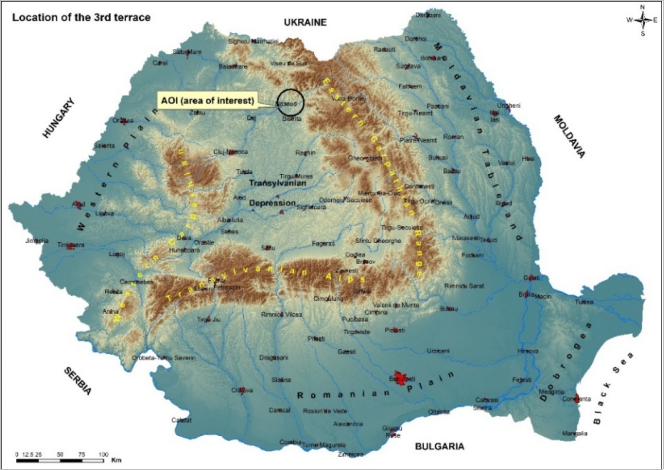
In the northeastern part of the Transylvania Basin, the valley of Someșul Mare, between the localities Ilva Mică and Salva, constitutes the boundary between the unit called Dealurile Năsăudului, to the north, and Dealurile Bistriței, to the south (Figure 1).
Figure 1. Location of the 3rd terrace in the Someşul Mare hydrographical basin.
From a morphological point of view, the Someșului Mare valley has the appearance of a strongly asymmetrical corridor, being one of the most typical subsequent valleys in the monoclinal relief of Romania.
North of Someşul Mare, the landscape is made up of structural surfaces, with slopes inclination to the south of 15-20 grade, made up of Miocene sandstones of Ottnangian-Carpathian (Burdigalian-Badenian) age. The structural surfaces here are part of an important monocline that constitutes the southern terminations of the Rodna Mountains towards the Transylvanian Depression. These surfaces carved in sandstone also pass to the south of the Someşului Mare valley, forming the cuesta front in which the 3rd terrace is formed.
Unlike the situation downstream from the confluence with Sălăuţa, where in the Someşului Mare valley terraces appear on both sides of the valley, in the upstream sector up to Ilva Mică, the terraces develop only on the left side of the valley due to the pronounced asymmetry of the relief caused by the southward inclination of the sandstone layers.
The terraces number in the northeastern Transylvanian Basin has been a continuing concern for researchers. Their results indicate four terraces , four terraces on Bistriţa and Şieu , three terraces on Tiha and four on Bistriţa . Compared to these, Gârbacea , through field research, identifies seven terrace levels, apart from the meadow terrace, which differs from three classical terrace levels, or seven terrace levels accepted by some geographers .
Regarding the numbering of the terraces, the Romanian school of geography uses the numbering done in reverse order of age, that is, the newest terrace has the index I, which increases with the age, II, III, etc. , because the newer terraces are easily visible compared to the old ones that have undergone intense modelling processes, which makes them difficult to identify in the field. The same numbering system was adopted in the present study.
Each hydrographic basin presents specific features related to the geological and geomorphological particularities of the relief unit of which it is a part. These are directly reflected in the number and relative altitude at which the terraces are placed within the valley.
The Mureş and Someş rivers have series of terraces numbering 8-9 levels . The terraces on Someşul Mare and Someşul Mic parallel in number and vertical development with those in the Bistriţa and Şieu basins, but also with the terraces in the Mureş basin, the connection being made based on the relative altitude criterion. These similarities in the geomorphological features of the terraces in the Transylvanian river basins lead to the conclusion that the main cause in the genesis of the terraces is a general one, probably dictated by the fluctuations of the base level in the Pannonian basin, but also the climatic conditions (alternation of glaciations with interglacial phases that determined the modification of the morpho-hydrological activity of rivers – incision/alluvial – at least in the case of more recent terraces .
The relative altitudes of the terraces within the hydrographic basins of Someşului Mare, Someşului Mic, Şieului and Mureşului are almost identical. Gârbacea stated years ago that all fluvial terraces, at least in Transylvania, located at the same relative altitude are synchronous, which allows us to make comparisons between the terraces on Someşul Mare, Someşul Mic, Mureş or Târnava Mică. Such a situation is specific to the platform regime in the Transylvanian Plateau, as opposed to the orogen regime in Romania, where the relative altitude of the fluvial terraces was modified by uplift processes.
For Someșul Mare, the altitudinal ranges of the terraces are as follows: t. I – meadow 2-3 m, t. II 6-8 m, t. III 18-25 m, t. IV 36-38 m, t. V 50 -55 m, t. VI 70-75 m and t. VII 90-114 m. The presence of higher terrace levels here is still debatable .
The relative altitude of the 3rd terrace from Rebrişoara (at the edge of the fragment called POD-"tread") is 20-21 m. Morphometrically, the terrace fragment containing the geomorphosite under study has an area of 48.05 ha, a length of 1.33 km, a width of 0.45 km and a general inclination, calculated at the surface of the last sedimentation level, of 1-2 degrees.
Simultaneously with the incision of Someşului Mare, the deepening of the tributaries from the left took place, the Suciului Valley which delimits the terrace tread to the west, but also the Podului valley located to the east. The last sector of the Pod valley is of particular interest to us because it separates the northern slope of Dealului Mărului (515 m) from the tread of the third terrace and in this way the denudation that took place on this slope could not contribute to the over-alluviation of the terrace. It follows that this over-alluviation resulted from the denudation that occurred only on the northern slope of the hilly massif that culminates at an elevation of 565 m. In this way, the surface affected by the denudation that produced the over-alluvial horizons can be precisely outlined.
3. Materials and Methods
OSL method
The Optical Stimulated Luminescence method was used to determine the age of the alluvium and sediments in the terrace deposit. This method involves the chronological dating of the materials by measuring the energy of the released photons. In the natural environment, ionized radiation (U, Th, Rb, K) is absorbed and stored in the crystalline structure of minerals from where it can be released in the form of luminescence through stimulation. Age is calculated as the time elapsed since the last exposure to sunlight or a strong heating. Luminescence dating is based on the radiation dose received by a mineral at the initial moment and the radiation dose accumulated over a specific period. The main minerals used in this method are quartz and potassium feldspars (https://www.usgs.gov/labs/luminescence-dating-laboratory).
Another important method for determining the age of the alluvium and sediments of the terrace deposits is Infrared-stimulated luminescence dating (IRSL) . For financial reasons we were not able to use this method here.
Sample collection
For the sample collection from the terrace formations, two locations were selected, aiming for the best conditions for capturing relevant profiles in the terrace deposit. Both, a complete development of the deposit profile and the relationship between the terrace deposits and the supra-alluvial (colluvial) material brought from the upper slope were pursued.
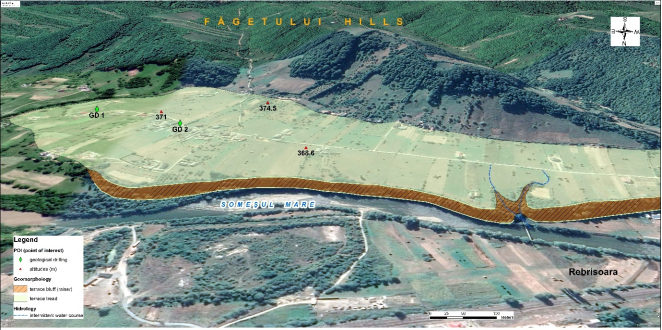
Two geologic drillings (GD1 and GD2) were carried out, from which several samples were collected. GD1 was named profile I, with samples taken from 3 m, 4 m and 5 m. GD2, named profile II, has samples taken from 1 m, 2 m, and 6 m and 8 m, where the gravel and sand horizon were reached at the base of the terrace formations.
Figure 2. The 3rd terrace of the Someşul Mare river near Rebrişoara village (POD).
The geographic coordinates of the collection points were taken from the field with the help of the "Mobile Topographer" GPS application. The coordinates of the Stereo 70' projection (used for the territory of Romania) calculated in meters were then transformed, for a better understanding, into degrees, minutes and seconds. Thus, survey GD1 has the coordinates of 24028'52" east and 47016'49'' north, and GD2 has the coordinates of 24048'43" east and 47016'55'' north.
Regarding the relative altitude of the collection points, we mention that GD1 has an absolute altitude value of 372.3 m, while for GD2 the value is 368.8 m. The difference in altitude between the two surveys is explained by their positioning, GD2 being located closer to the top of the terrace, while GD1 is located towards the side of the terrace where the thickness of the supra-alluvium increases as it approaches the upper slope that has been subjected to denudation processes (Figure 2).
The geologic drillings were carried out with a Heavy Dynamic Penetrometer (DPH) having a cone penetration shape with a ram mass of 50 kg. The extracted samples were closed in thermoplastic (PVC) tubes and transported to the laboratory.
From the two surveys drillings, volumes of materials were collected in accordance with the requirements of the methodology for collecting samples from the field for OSL analysis. For each sample, 200-300 mg of silt with a granulometry between 4-11 microns (100 mg being sufficient) and a few grams of fine sand, with a granulometry between 90-125 microns, were collected. In addition to these, in each case around 1kg of material was collected to determine the humidity index.
Sample preparation and analysis
Sample preparation and analytical procedure for SAR-OSL age calculation were performed by PhD Gyorgy Sipos and his team at the Luminescence Dating Laboratory, Department of Geoinformatics, Physical and Environmental Geography, University of Szeged, Hungary.
All procedures were carried out in subdued yellow light provided by a low-pressure Na lamp (maximum emission at 589 nm), filtered by a Schott BG 18 glass in order to cut possible near infrared and infrared wavelengths. Water content was determined as follows: (tw-td)/td, where tw and td are wet and dry weight of the sample, respectively. Sample preparation followed the procedures listed in the work flow below.
The samples were then subjected to the process of removing carbonates, being treated with HCl (10% concentration) and likewise for the removal of organic matter, the samples were treated with H2O2 (10% concentration). In both cases the treatment of the samples lasted 2-3 days. Later, the granulometric fraction of 4-11 µm was obtained by wet sieving (Table 1).
Table 1. Data on sample preparation.

Field ID

Lab ID

grain size (µm)

mineral*

w (%)**

II. 1 m

OSZ 2506

4-11

P

19 ± 5

II. 2 m

OSZ 2507

4-11

17 ± 5

I. 3 m

OSZ 2438

4-11

17 ± 5

I. 4 m

OSZ 2298

4-11

18 ± 5

I. 5 m

OSZ 2299

4-11

17 ± 5

II. 6 m

OSZ 2300

4-11

19 ± 5

II. 8 m

OSZ 2302

4-11

16 ± 5

* P: polymineral
** w: water content
Luminescence measurements
All luminescence measurements were carried out using a RISØ TL/OSL DA-20 luminescence reader equipped with a calibrated 90Sr/90Y source. Stimulation was carried out using either blue (470 nm) or IR (870 nm) LEDs, depending on the applied mineral fraction. Detection was made through either a U-340 filter (quartz) or the combination of BG39 and CN-7-59 filters (feldspar) and polymineral fractions.
Throughout the measurements the Single Aliquot Regeneration (SAR) protocol was used for quartz and the so called pIRIR procedure for feldspar and polymineral sampled .
Prior to the measurement of the equivalent dose (De) tests were carried out to determine optimal temperature parameters and the reproducibility of the SAR procedure (combined preheat and dose recovery test).
The equivalent dose was determined on several aliquots in case of each sample. Only those aliquots were considered for De calculation which passed the following rejection criteria (recycling ratio: 1.00±0.10; maximum dose error: 10%; maximum recuperation: 5%, maximum IR/OSL depletion ratio: 5%). Sample De was determined based on each accepted aliquot De, using different statistical techniques . Decision was made based on over dispersion, skewness and kurtosis values.
Dose rate measurement
Environmental dose rate D* was determined using high resolution, extended range gamma spectrometer (Canberra XtRa Coaxial Ge detector). Dry dose rates were calculated using the conversion factors of . Wet dose rates were assessed based on in situ water contents. The dose rate provided by cosmic radiation was determined based on the geographical position and depth of the samples below ground level, using the equation of Prescott and Hutton (Table 2).
Table 2. Age calculation and results.

Field ID

Lab ID

Depth (cm)

Water content (%)

U (ppm)

Th (ppm)

K (%)

Age model1

D*2 (Gy/ka)

De3 (Gy)

Age (ka)

II. 1 m

OSZ 2506

100

15 ± 5

2.88±0.59

8.26±1.53

1.85±0.46

Mean±SE

3.79±0.26

115.1±8.5

30±3

II. 2 m

OSZ 2507

200

15 ± 5

2.36±0.46

7.26±1.21

1.85±0.46

Mean±SE

3.46±0.22

290.4±20.5

84±8

I. 3 m

OSZ 2438

300

17 ± 5

1.93±0.03

8.27±0.17

1.5±0.04

Mean±SE

2.7±0.15

275.3±11.2

102±7

I. 4 m

OSZ 2298

400

18 ± 5

2.03±0.04

8.22±0.19

1.87±0.05

Mean±SE

3.00±0.23

359.2±17.8

120±11

I. 5 m

OSZ 2299

500

17 ± 5

1.98±0.04

7.69±0.17

1.63±0.05

Mean±SE

2.72±0.21

311.1±49.8

114±20

II. 6 m

OSZ 2300

600

19 ± 5

2.03±0.03

9.03±0.19

1.87±0.05

Mean±SE

3.02±0.24

387.4±64.1

128±23

II. 8 m

OSZ 2302

800

16 ± 5

2.16±0.04

10.25±0.23

2.09±0.06

Mean±SE

3.44±0.28

500<

145<

1Age model: Procedure used to calculate age. Mean±SE (mean and standard error of data), MAM (Minimum Age Model), CAM (Central Age Model), FMM (Finite Mixture Model)
2 total dose rate
3 equivalent dose
4. Results and Discussions
The data obtained from the analysis of samples from the terrace deposit provide information related to the geological age, but do not provide direct information regarding the time of incision and development of the terrace.
The new ages obtained provide information on the time of sedimentation of the horizons of the terrace deposit and can be considered the maximum age limit for terrace development (Tooth, 2013), because the time between the deposition of terrace deposits and the moment of river incision and terrace development can be very long. The ages obtained for the terrace deposits vary between the middle period of the end of the Riss glaciation (145 kyr) and up to Würm 1 (84±8 kyr) (see table 2).
Three samples were collected from profile I, from 3 m, from 4 m and from 5 m. Following the OSL analysis, their ages were established, respectively the end of the Eemian for both, the samples from 4 m (114±-20 kyr) and the sample from 5 m (120±-11 kyr) and Early Weichselian, for the sample from 3 m (102±-7 kyr), (see table 2).
From the profile II, the samples were collected from 1 and 2 m, then from 6 m, and from 8 m. Based on the OSL analysis, it was confirmed that the age of the sample from 8 m, the oldest, is about 145 kyr, a fact that places it at the end of the Riss / Saale period (the substadial Drenthe, Warthe). The sample from 6 m with an age of 128±-23 kyr should be placed, the same, at the transition between Saalian period and Eemian.
Finally, the material from sample 2 has an age of 84±8, which places it at the end of the Rederstall stadial, and in the case of sample 1 an age of 30±3 kyr was recorded, which places this sample at the end of the interstadial Denekamp of the Pleniglacial. The age difference between sample 2 and sample 1 can only be explained by the fact that there was a sedimentation gap between the deposition of the materials from the two samples, probably due to the beginning of the vertical incision of the Someşul Mare river and the deepening below the level of the last layer of alluvium from the terrace tread surface . At the same time, the material located above 2 m depth of the borehole no longer corresponds to the river alluvium, but represents the colluvial material that was brought from the upper slope of the terrace.
Based on the recorded age, the oldest sample, sample 8, is placed in the terminal part of the Saale glaciation in Riss, which ended 130 kyr ago. The Saale was marked by the maximum of glacial extension in the Drenthe/Warthe phase. The weathering processes had a particular intensity, producing materials such as boulders, pebbles, coarse sand, which will later form the lower horizons of the 3rd terrace deposit. We must stress the fact that the sample collected from 8 m is composed of material with a fine granulometry, at the limit to gravels and coarse sands. We therefore have no information related to the thickness of the coarse alluvial horizon at the base of the terrace deposit.
The Eemian was the most important interglacial period before the Holocene , lasted between 130-115 kyr BP and was considered the warmest period in the last 800 kyr . Much current research focuses on Pleistocene interglacials to better understand current and future climate variability. The interglacial present in which we find ourselves is compared to MIS 5e (Eemian) or MIS 11 (Holstein Cromer/Rhume), . During this period the temperatures were at least 20°C higher than today and the ocean level was 4-6 m higher than today (important marine transgression). These were very suitable conditions for the alluvium of large quantities of materials in the former river meadows (current 3rd terraces).
The materials from the samples collected from 6 m, 5 m, and 4 m correspond to the Eemian, whose ages are between 128 and 114 kyr.
The Eemian was followed by the Weichselian which began ca. 117 kyr and was completed 11.7 kyr ago. It was a period marked by a succession of glacial stadials and warmer interstadials, divided into three epochs: Early Weichselian (117-57 kyr), High Glacial or Pleniglacial (57-15 kyt) and Late Glacial (12.5-11, 5 kyr), .
The early Weichselian begins with a strong decrease in temperature in the cold Herning stadial, which took place between 117-105 kyr, corresponding to MIS 5d .
The second subdivision of the early Weichselian is the Brørup interstadial between 105-93 kyr, corresponding to MIS 5c. Coniferous forests developed during it, which suggests that Brørup was quite warm, probably warmer than other Weichselian interstadials (Figure 3). The sample from the depth of 2 m corresponds to this period.
The Rederstall stage represents the second stage of the early Weichselian and is between 93 and 85 kyr, correlated with MIS 5b. Temperatures dropped during this time when an important episode of ice cap expansion took place in northern Europe (Figure 3).
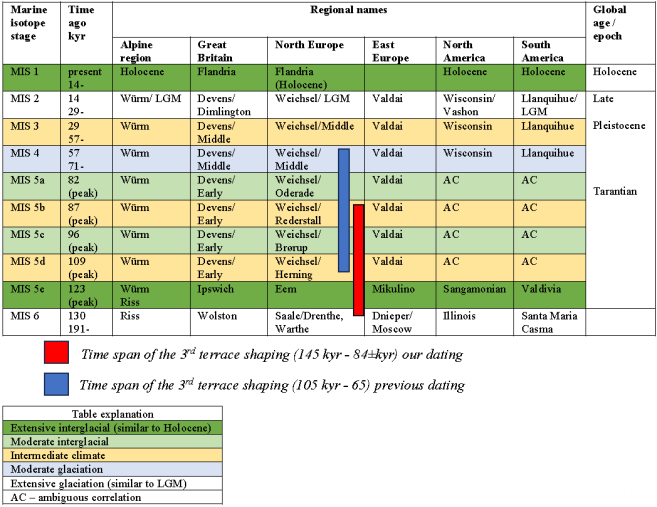
From the correlation of the age established by us for the alluvium with the chronology of marine isotopes (MIS – Marine Isotope Stage) recognized worldwide, it follows that the alluviation of the terrace began at the end of the MIS 6 stage corresponding to the end of the Riss/Saale glaciation (Drente, Warthe – 145 kyr ago), continued through the periods MIS 5e Riss-Würm/Eemian (interglacial) and MIS 5d Weichselian/Herning (glacial), then MIS 5c Weichselian/Brørup (interstadial).
As a result, the newest deposits of the 3rd terrace with the chronology established by marine isotope dating belong to the MIS 5b phase, a stadial period that makes the transition from the early to the middle Würm, a phase that followed the first two stadial of the last glaciation.
Figure 3. Correlation table between Quaternary subdivisions, their ages and correspondence with MIS .
It follows that the time during which the alluvium of the 3rd terrace was accumulated was very long (~60 kyr), the deposition starting with the gravels and even the boulders from the base rolled in the mentioned stadials (the lower part of MIS 6 and up to the lower part of MIS 5b), ending with fine alluvium (sands and silts) from the upper part (Figure 3).
Consequently, the paleoclimatic conditions during the stadials, at the beginning of the Weichselian, were not suitable for the formation (on the southern slopes of the Rodna Mountains) of an appreciable volume of unconsolidated deposits of debris, which then arrived in the valleys to form boulders and rounded pebbles as a result of fluvial transport (including by dragging, taking into account the reduced flows from the stadiums) that are found at the base of the 3rd terrace, from Rebrişoara.
Over the alluvium of the terrace, starting with the Oerel and Glinde interstadials of the Pleniglacial, , the deposition of colluvial materials from the upper slope began, materials that reach around 2 m in thickness in the area of geological drilling and increase in size up to several m near the base of the slope.
An important event in the evolution of the terrace is the time of the beginning of the incision and the rate of vertical deepening of the Someşul Mare river.
The determination of the incision rate was calculated using the linear relationship between the height of the terrace tread and its minimum age . The calculation formula is I ¼ h=t, where I represents the river incision rate in the terrace, h is the relative elevation of the terrace, calculated between the surface of the terrace bridge and the riverbed at its lowest point, and t represents the minimum age of the last fine horizon of terrace warehouse .
Considering the relative altitude of the 3rd terrace, of 20-21 m and the minimum age of the last level of alluvium of 84±8 kyr, an average rate of incision of Someşului Mare of ~ 0.25 mm/year results. However, if we take into account the fact that after the deposition of the last layer of alluvium there follows a series of interstadials (Odderade, at the end of the early Weichselian, Oerel, Glinde, Moersshoofd, Hengelo and Denekamp, all from the Pleniglacial), interrupted only by short stadials, Schalkholz and Ebersdorf , we can "push" the time of the beginning of terrace incision much later, somewhere at 30-40 kyr, a time corresponding to the beginning of covering the terrace tread with colluvial materials from the upper slope, which would lead to an incision rate terrace much higher than the one calculated at the moment.
The opinions on the age of the 3rd terrace are contradictory in scientific literature depending on the author. In most cases, a Würmian age is considered, ex. on the Dniester, Tighina terrace of 18-22 m, in Würm I ). Other authors consider that the 3rd terrace was formed in the Middle Weichselian, respectively in Würm II.
According to Jakab one of the best connoisseurs of Transylvania geomorphology, the fill with alluvium of the 20-30 m terrace on Mureş river (the fragment located north of Târgu Mureş), considering the presence of fossil remains of (Elephas) Mammuthus primigenius Blum, occur at the beginning of the last glaciation (Würm/Weichselian) .
The age dating also considered the occurrence in outcrop of two fossil soils (Jakab, Sipos, 1970) formed later (in WI–WII and respectively WII–WIII). The authors reaching the conclusion that the 3rd terrace has a Würmian age. To the arguments above, we add the observations made by N. Josan (1979) regarding the periglacial structures (represented by pockets and fringes) that appear in the alluvium of the 3rd terrace on Târnava Mică, at Adămuş.
Posea states that the alluvial layer of the 3rd terrace on Someşul Mic (in Floreşti) accumulated during the last but one glaciation, and Mac believes that the 3rd terrace in the Subcarpathians of Transylvania was shaped in the Upper Pleistocene.
Pendea places the age of the 3rd terrace in the Middle Pleniglacial . That period was characterized by the rapid and repeated succession of mesothermal episodes (short interstadials Oerel, Glinde, Meershoofd, Hengelo) with microthermal periods that determined an accentuated paraglacial torrentiality on the left slope of Someșului Mic .
In his determination, the mentioned author also considered the establishment of an absolute age (based on radiocarbon) of 60-40 kyr for the "sieved" deposits that cover (being therefore newer) the alluvium of the 3rd terrace from Floreşti (Cluj County), from Someşul Mic. By this he contradicts the assertions made by Posea , stating that the alluvial formations of the 3rd terrace in Floreşti, on the left bank of the Someşlui Mic, were not formed in the Early Weichselian considering the restrictive climatic nature of this period, marked by long and warm interstadials (Brørup and Odderade) and Herning & Rederstall stadials were too short for the accumulation of terrace alluvium .
It is worth to emphasize that the previous studies place the beginning of the formation of the 3rd terrace, both on the rivers inside the Carpathian arc and those outside, in the best case in the early Weichselian, at the beginning of the Herning stadial, and the end of the development somewhere in the middle Weichselian, in the Oerel/Glinde phases.
The 3rd and 4th terrasses are widely developed in the river valleys of Transylvania (outside the meadow terrace), consequently their incision must be correlated with the period of maximum development of the penultimate and last glaciations.
For the 3rd terrace, this phenomenon did not happen at the beginning of the Weichselian glaciation because the stages had a relatively short duration (between 8-13 kyr), and the temperatures were higher than in the following periods corresponding to the middle Weichselian also called High Glacial or Pleniglacial, which took place between 57-15 kyr.
This fact is also supported by De Clercq et al. , which shows that the Weichselian is marked by a drop in the level of the Atlantic Ocean accompanied by an intense cooling of the climate which determined a strong incision of the valleys in western Europe with values between 15 and 20 m. This effect was certainly transmitted and regional base levels in central and eastern Europe.
The evidence brought by us through the OSL dating method shows a much older age of the sedimentation of the first deposits and a much newer age regarding the final moment of sedimentation and the beginning of the vertical incision of the Someșului Mare river.
Dating by the OSL method for determining the age of the deposits of the IIIa terrace is the first of its kind for the situation of the rivers in the north-western half of Romania.
5. Conclusion
The problem of the Romanian terraces raised a keen interest among Romanian geomorphologists from early time and focused numerous studies dedicated to solving it. The large number of authors also meant many different methodological approaches whose results were in most cases contradictory.
The position of the two general base levels, the Pannonian which attracted the rivers from the northwest of Romania and the Dacian towards which the rivers from the south and east of the Carpathians headed, neotectonics and climate variations of the last 130 kyr, determined important differences between the internal and external parts of the Carpathians, related to the moments of deposition of the terrace deposits and those of their incision.
In the case of the terraces in the hydrographic basins of the Someş and Mureş rivers, there are numerous similarities regarding the morphometry, the thickness of the deposits and the time of incision of the terraces. The control achieved by the Pannonian base level determined the aggradation of the terraces corresponding to the rise of the sea level and incisions with its lowering.
In addition to the classical methods in the study of terraces (observation, morphometric measurements in the field, corroborations with similar elements from other hydrographic basins), the age of the deposits of 3rd terrace on Someşul Mare was determined using the OSL method, a method applied to a number of 7 material samples collected from two geological boreholes.
For the two important moments in the "life" of the terrace, the elapsed time during which the terrace alluvium was deposited and the onset followed by the period of incision of the terrace front, the information is different. The ages of the terrace deposit obtained by the OSL method showed a long period of deposition, of about 61 kyr, between the middle period of the end of the Riss glaciation (145 kyr) and up to Würm 1 (84±8 kyr). Instead, the age of the moment of the beginning of the terrace incision and the elapsed period for shaping the terrace front was deduced indirectly, based on the correlation with the time elapsed since the alluviation of the last horizon of the terrace deposit and with the beginning of the covering of the terrace tread with colluvial materials from the upper slope.
From the correlation of the age established by us for the alluvium with the chronology of marine isotopes (MIS – Marine Isotope Stage) recognized worldwide, it follows that the fill with alluvium of the terrace began at the end of the MIS 6 stage, corresponding to the end of the Riss / Saale glaciation (Drente, Warthe – 145 kyr ago), continued throughout the MIS 5e Riss-Würm / Eemian stage, and Weichselians stages Herning, Brørup.
If we consider the absolute age of the older deposits, from 8 m deep, from survey 2 (145 kyr ago), it follows that the 3rd terrace is much earlier than the older determinations and the current ones from the specialized literature in Romania. Moreover, the coarse horizon at the base, from which we did not collect samples for this type of determination, shows an even longer time for the formation of the terrace deposit.
In other words, the 3rd terrace of the Someşului Mare river, and we can extrapolate the statement to the other synchronous terraces, at least in the north of the Transylvanian Basin, were shaped much earlier than was known until now. This is the first dating of this type that concerns terraces number 3rd in Transylvania. We are referring, of course, to the geological age of the terrace.
Abbreviations

OSL

Optical Stimulated Luminescence

IRSL

Infrared Stimulated Luminescence

SAR

Single Aliquot Regeneration

MIS

Marine Isotope Stage

Author Contributions
Garbacea Virgil Achiles: Funding acquisition, Project administration, Resources, Supervision
Buzila Liviu-Ioan: Conceptualization, Data curation, Formal Analysis, Investigation, Methodology, Resources, Software, Validation, Writing – original draft, Writing – review & editing
Hodor Nicolaie: Data curation, Funding acquisition, Investigation, Resources, Validation
Conflict of Interest
The authors declare no conflicts of interest.
References
[1] Adamiec G., Aitken M. 1998. Dose rate conversion factors: update. Ancient TL, 16/2: 37-49.
[2] Armaş, Iuliana, Necea, Diana, Miclăuş, Crina (2018), Fluvial terrace formation and controls in the Lower River Danube, SE Romania, in Quaternary International, Elsevier.
[3] Atanasiu, L. (1951-1952), Geologia regiunii Fântânele-Mureşenii Bârgăului (Năsăud), D. S. Com. Geol., XXXIX.
[4] Băcăuanu, V. (1984), Consideraţii geomorfologice asupra repartiţiei monolaterale alternative a teraselor fluviale din Podişul Moldovei, Lucr. Sem. geogr. “Dimitrie Cantemir”, 4 (1983).
[5] Badea, L. (1967), Subcarpaţii dintre Cerna Olteţului şi Gilort. Studiu geomorphologic, Edit. Acad., Bucureşti.
[6] Badea, L. (1983), Terasele fluviale, Geografia României, vol I, Edit. Acad. R. S. R., Bucureşti.
[7] Bălescu, S., Lamothe, M., Panaiotu, C., Panaiotu, C. (2010), La chronologie IRSL des séquences loessiques de l'est de la Roumanie. Quaternaire 21(2), 115–126.
[8] Böse et al. (2012), Quaternary Glaciations of Northern Europe, Quaternary Science Reviews (44): 17, CiteSeerX 10.1.1.734.1691.
[9] Brătescu, C. (1941), Contribuţii la cunoaşterea văii Nistrului, B. S. R. R. G., LIX.
[10] Burbank, D. W., Anderson, R. S. (2001) Tectonic Geomorphology. Blackwell Science, Massachusetts, USA, p. 274.
[11] Buylaert J. P., Jain M., Murray A. S., Thomsen K. J., Thiel C., Sohbati, R. (2012): A robust feldspar luminescence dating method for Middle and Late Pleistocene sediments. Boreas, 41(3), 435–451.
[12] Ciocârdel, R. (1948-1949), Contribuţii la cunoaşterea geologiei regiunii Bistriţa-Reghin, D. S. Instit. Geol. Rom., XXXVI.
[13] De Clercq, M., Missiaen, T., Walliga, J., Hurtado, Z. O., Versendal, A., Mathys, M., De Batist, M., (2018), A well-preserved Eemian incised-valley fill in the southern North Sea Basin, Belgian Continental Shelf - Coastal Plain: Implications for northwest European landscape evolution, in Earth Surface Processes and Landforms, 43(9).
[14] Dodson, J. (ed.), (2010), Earth Systems and Society, New York, London, etc., Springer.
[15] Fuchs, H., Konya, I. (1967), Noi fosile de rinocer lânos (Coelodonta antiquitatis Blumenbach) din cuaternarul Târnavei Mici, Studii şi Materiale II, Muzeul Judeţea, Târgu Mureş.
[16] Galbraith, R. F., Roberts, R. G., Laslett, G. M., Yoshida, H. and Olley, J. M. (1999), Optical dating of single and multiple grains of quartz from Jinmium rock shelter, northern Australia: part I, exp erimental design and statistical models, Archaeometry, 41, 339 -364.
[17] Gârbacea, V. (2015), Dealurile Bistriţei şi Gurghiului, Presa Universitară Clujeană.
[18] Gârbacea, V. (1957), Terasele Bistriţei ardelene şi ale Şieului, Bul. Univ. “Babeş-Bolyai”, Şt. nat., I, 1-2.
[19] Haoran, Z, Xiao, F., Zaijun, L, Yujie, G, Xisoping, Y. (2022), Multi-method pIRIR dating of sedimentary sequences at the southern edge of the Gurbantunggut Desert, NW China and its paleoenvironmental implications, Quaternary Geochronology, vol. 70, 101300, Elsevier.
[20] Jakab, S. (2007), Chrono-toposequences of soilon the river terraces in Transylvania (Romania), in Catena 71, 406-410.
[21] Kren, Fr. (1940), Das Nösnerland als Lebentsraum einer deutschen Volkgruppe in Siebenbürgen eine länderkundliche untersuchung, Geogr. Jaresbericht aus Österreich, 22, Wien.
[22] Liritzis, I., Stamoulis, K., Papachristodoulou, C., and Ioannides, K. (2013): A re-evaluation of radiation dose-rate conversion factors. Mediterranean Archaeology and Archaeometry, Vol. 13, No 3, pp. 1-15 Copyright.
[23] Litt, Th., Behre K. E., Meyer K. D, Stephan, H. J., Wansa, S. (2007), T. Litt im Auftrag der Deutschen Stratigraphischen Kommission (ed.), "Stratigraphische Begriffe für das Quartär des norddeutschen Vereisungsgebietes", Stratigraphie von Deutschland – Quartär. Special Issue. Eiszeitalter und Gegenwart/Quaternary Science Journal (in German), vol. 56, No. 1/2, Stuttgart: E. Schweizerbart’sche Verlagsbuchhandlung (Nägele und Obermiller), pp. 7–65.
[24] Lokrantz, Hanna; Sohlenius, G. (2006), Ice marginal fluctuations during the Weichselian glaciation in Fennoscandia, a literature review (Technical Report TR-06-36), Stockholm: Svensk Kärnbränslehantering AB (Swedish Nuclear Fuel and Waste Management Co).
[25] Mac, I. (1972), Subcarpaţii transilvăneni dintre Mureş şi Olt, Studiu geomorfologic, Ed. Acad., Bucureşti.
[26] Mihăilescu, V. (1939), Quelques notes sur les terrasses de rivières en Roumanie, Rev. Geogr. Rom., II, 1.
[27] Morariu, T, Gârbacea, V. (1960), Terasele râurilor din Transilvania, Com. Acad., X, 6.
[28] Morariu, T., Mihăilescu, V., Rădulescu, I., Grumăzescu, A., Badea, L., Gârbacea, V. (1960), Le stade actuel des recherches concernant les terraces fluviales dans la R. P. Roumanie, in vol. Recueil d’études géogr., concernant le territoire de la R. P. Roumanie, Edit. Acad., Bucharest.
[29] Morariu, T., Donisă, I. (1968), Terasele fluviale din România, St. cerc. geol., geof., geogr., seria geogr., 1.
[30] Murray A. S., Wintle A. G. (2000): Luminescence dating using an improved single-aliquot regenerative-dose protocol. Radiation Measurements 32, 57-73 pp.
[31] Murray A. S. és Wintle A. G. (2003): The single aliquot regenerative dose protocol: Potential for improvements in reliability. Radiation Measurements 37(4), 377-381 pp.
[32] Necea, Diana, Fielitz W, Kadereit A., Andriessen, P. A. M., Dinu, C. (2013), Middle Pleistocene to Holocene fluvial terrace development and uplift-driven valley incision in the SE Carpathians, Romania, in Tectonophysics, Elsevier, pp. 332-354.
[33] Past Interglacials Working Group of PAGES, 2016. Interglacials of the last 800.000 years, Rev. Geophys. 54, 162-219.
[34] Pendea, I. F. (2005), Paleomediile geomorfologice ale Cuaternarului superior în Depresiunea Transilvaniei (Eemian-Weichselian). PhD thesis, unpublished.
[35] Pop, Gh. (1961), Rolul variaţiilor climatice postglaciare şi formarea teraselor inferioare pe valea Someşului Cald, Studia “UBB”, Cercet. geol.-geogr., 1.
[36] Popescu, N., Ielenicz, M., Posea, Gr. (1973), Terasele din România, in Realizări în geografia României, Edit. Ştiinţifică, Bucharest.
[37] Posea, Gr. (1961), Profil periglaciar la Floreşti, Com. Acad., 11, 1.
[38] Posea, Gr., Popescu, N., Ielenicz, M. (1974), Relieful României, Edit. Ştiinţifică, Bucharest.
[39] Prescott J. R., Hutton J. T. 1994. Cosmic ray contributions to dose rates for luminescence and ESR dating: large depths and long-term variations. Radiation Measurements, 23: 497-500.
[40] Savu, Al., Mac, I, Tudoran, P. (1970), Aspecte privind geneza şi vârsta teraselor din Transilvania, în Realizări în Geografia României, Culegeri de studii, Ed. Şt., Bucureşti.
[41] Schirmer, W. (1995), Quaternary field trips in central Europe, Volume 1, Pfeil.
[42] Savu, Al., Clichici, O., Dragos, I. (1970), Contribuţii la problema vârstei teraselor Someşului Mare, SUBB – geogr, XV, 2.
[43] Savu, Al., Mac, I., Tudoran, P. (1973), Aspecte privind geneza şi vârsta teraselor din Transilvania, în vol. Realizări în Geografia României, Culegere de studii, Edit. ştiinţifică, Bucureşti.
[44] Shackleton, N. J. Sánchez-Goñi, Maria Fernanda, Pailler, Delphine, Lancelot, Y. (2003),"Marine Isotope Substage 5e and the Eemian Interglacial", Global and Planetary Change, 36(3), 151–155, 2003,
[45] Spirescu, M. (1970), Loessuri şi soluri fosile, STE, Seria C, Pedol., VI, IG.
[46] N. J. Sánchez-Goñi, Maria Fernanda, Pailler, Delphine, Lancelot, Y. (2003),"Marine Isotope Substage 5e and the Eemian Interglacial", Global and Planetary Change, 36(3), 151–155. 2003,
[47] Thiel C., Buylaert J., Murray A., Terhorst B., Hofer I., Tsukamoto S., Frechen M. (2011): Luminescence dating of the Stratzing loess profile (Austria) Testing the potential of a levated temperature post-IR IRSL protocol. Quaternary International, 234(1–2), 23–31 pp.
[48] Tooth, S., 2013. Luminescence, geomorphological processes. In: Rink, W., Thompson, J. (Eds.), Encyclopedia of Scientific Dating Methods. Springer, Dordrecht, pp. 470–475.
[49] Tornqvist, T. E., Wallinga, J., Murray, A. S., de Wolf, H., Cleveringa, P. and de Gans, W. (2000), Response of the Rhine-Meuse system (west-central Netherlands) to the last Quaternaryglacio-eustatic cycles: a first assessment. Global and Planetary Change, 27(1-4): 89-111. 2000,
[50] Wintle A. G., Murray A. S. 2006. A review of quartz optically stimulated luminescence characteristics and their relevance in single-aliquot regeneration dating protocols. Radiation Measurements 41: 369-391.
[51] Subcommission on Quaternary Stratigraphy, global chronostratigraphical correlation table for the last 2.7 My, 2011.
Cite This Article
  • APA Style

    Achiles, G. V., Liviu-Ioan, B., Nicolaie, H. (2024). The Absolute Age First Determination of the 3rd Terrace Deposits from Transilvania, Using Optically Stimulated Luminescence Method. Earth Sciences, 13(5), 182-192. https://doi.org/10.11648/j.earth.20241305.11

    Copy | Download

    ACS Style

    Achiles, G. V.; Liviu-Ioan, B.; Nicolaie, H. The Absolute Age First Determination of the 3rd Terrace Deposits from Transilvania, Using Optically Stimulated Luminescence Method. Earth Sci. 2024, 13(5), 182-192. doi: 10.11648/j.earth.20241305.11

    Copy | Download

    AMA Style

    Achiles GV, Liviu-Ioan B, Nicolaie H. The Absolute Age First Determination of the 3rd Terrace Deposits from Transilvania, Using Optically Stimulated Luminescence Method. Earth Sci. 2024;13(5):182-192. doi: 10.11648/j.earth.20241305.11

    Copy | Download

  • @article{10.11648/j.earth.20241305.11,
      author = {Garbacea Virgil Achiles and Buzila Liviu-Ioan and Hodor Nicolaie},
      title = {The Absolute Age First Determination of the 3rd Terrace Deposits from Transilvania, Using Optically Stimulated Luminescence Method
    },
      journal = {Earth Sciences},
      volume = {13},
      number = {5},
      pages = {182-192},
      doi = {10.11648/j.earth.20241305.11},
      url = {https://doi.org/10.11648/j.earth.20241305.11},
      eprint = {https://article.sciencepublishinggroup.com/pdf/10.11648.j.earth.20241305.11},
      abstract = {For determining the absolute age of the terrace deposits, a geomorphosite located on the left side of Someşul Mare river, southeast of Rebrişoara was selected, which includes a fragment of the tread of the 3rd terrace (20-21 m relative altitude) and the cuesta slope, facing north the Făgetului Hills. The question regarding the age of fluvial terraces has been long debated in Romanian geomorphological literature age since the beginning of the 20th century. Many geomorphologists have carried out studies wherein the question of the age of the terraces, both inside the Carpathian curvature and outside, was raised. Most of the studies carried out for the terraces on the rivers of the Transylvanian Basin indicated the age of the 3rd terrace as Wurmian. Until recently, most assumptions related to the age of the terraces were based on the correlation between terraces and/or by dating the paleontological fossils discovered in the terrace deposits. Recent studies, on the other hand, use high-precision methods to determine the ages of terrace formations. Researchers, use methods like the Infrared-stimulated luminescence dating (IRSL) and SAR-OSL (Optically Stimulated Luminescence). Within this context, the present study focuses on the attempt to determine the age of the 3rd terrace in the corridor of the Someșul Mare river. In the alluvial formations of this terrace, two geologic drillings were carried out from where several samples were collected. They were subjected to OSL analysis at the Luminescence Dating Laboratory, Department of Geoinformatics, Physical and Environmental Geography, University of Szeged, Hungary. The results showed an older age of the 3rd terrace than it has been believed until now.
    },
     year = {2024}
    }
    

    Copy | Download

  • TY  - JOUR
    T1  - The Absolute Age First Determination of the 3rd Terrace Deposits from Transilvania, Using Optically Stimulated Luminescence Method
    
    AU  - Garbacea Virgil Achiles
    AU  - Buzila Liviu-Ioan
    AU  - Hodor Nicolaie
    Y1  - 2024/09/26
    PY  - 2024
    N1  - https://doi.org/10.11648/j.earth.20241305.11
    DO  - 10.11648/j.earth.20241305.11
    T2  - Earth Sciences
    JF  - Earth Sciences
    JO  - Earth Sciences
    SP  - 182
    EP  - 192
    PB  - Science Publishing Group
    SN  - 2328-5982
    UR  - https://doi.org/10.11648/j.earth.20241305.11
    AB  - For determining the absolute age of the terrace deposits, a geomorphosite located on the left side of Someşul Mare river, southeast of Rebrişoara was selected, which includes a fragment of the tread of the 3rd terrace (20-21 m relative altitude) and the cuesta slope, facing north the Făgetului Hills. The question regarding the age of fluvial terraces has been long debated in Romanian geomorphological literature age since the beginning of the 20th century. Many geomorphologists have carried out studies wherein the question of the age of the terraces, both inside the Carpathian curvature and outside, was raised. Most of the studies carried out for the terraces on the rivers of the Transylvanian Basin indicated the age of the 3rd terrace as Wurmian. Until recently, most assumptions related to the age of the terraces were based on the correlation between terraces and/or by dating the paleontological fossils discovered in the terrace deposits. Recent studies, on the other hand, use high-precision methods to determine the ages of terrace formations. Researchers, use methods like the Infrared-stimulated luminescence dating (IRSL) and SAR-OSL (Optically Stimulated Luminescence). Within this context, the present study focuses on the attempt to determine the age of the 3rd terrace in the corridor of the Someșul Mare river. In the alluvial formations of this terrace, two geologic drillings were carried out from where several samples were collected. They were subjected to OSL analysis at the Luminescence Dating Laboratory, Department of Geoinformatics, Physical and Environmental Geography, University of Szeged, Hungary. The results showed an older age of the 3rd terrace than it has been believed until now.
    
    VL  - 13
    IS  - 5
    ER  - 

    Copy | Download

Author Information