Review Article | | Peer-Reviewed

Crustal Evolution of the Southern Part of the Toumodi-Fetekro Belt: Petro-Structural Study of the Geological Formations of Anikro Hill (Côte d’Ivoire, WAC)

Received: 18 July 2026     Accepted: 27 July 2026     Published: 22 August 2026
Views:       Downloads:
Abstract

The Anikro hill chain is located in the southern part of the Toumodi–Fetekro greenstone belt, specifically northeast of Anikro village. This study aims to improve the understanding of the petrography, structural geology, and associated mineralization of the Anikro hill chain. To achieve this objective, a petro-structural investigation of the different geological formations was carried out. Field observations combined with petrographic examination under the microscope enabled the identification and characterization of the various mineral parageneses. The brittle and ductile deformation structures recognized in the field were used to construct rosette diagrams in order to determine the principal structural trends. The lithologies identified in the Anikro area are exclusively igneous rocks, including plutonic rocks (granite and diorite), dykes rocks (microdiorite and aplite), and volcanosedimentary rocks (cinerite, tuff, and volcanic breccia). The diorite, microdiorite, and volcanosedimentary rocks originated from basic magmatism and were subsequently intruded by a granitic pluton derived from late-stage acidic magmatism. These rock units were affected by low-grade metamorphism corresponding to the greenschist facies. Structurally, three deformation mechanisms were identified: brittle deformation, folding, and shearing. The dominant fracture orientation within the study area is NNE.

Published in Earth Sciences (Volume 15, Issue 4)
DOI 10.11648/j.earth.20261504.15
Page(s) 205-215
Creative Commons

This is an Open Access article, distributed under the terms of the Creative Commons Attribution 4.0 International License (http://creativecommons.org/licenses/by/4.0/), which permits unrestricted use, distribution and reproduction in any medium or format, provided the original work is properly cited.

Copyright

Copyright © The Author(s), 2026. Published by Science Publishing Group

Keywords

Anikro, Toumodi-Fetekro Belt, Geological Formations, Petro-Structural Study

1. Introduction
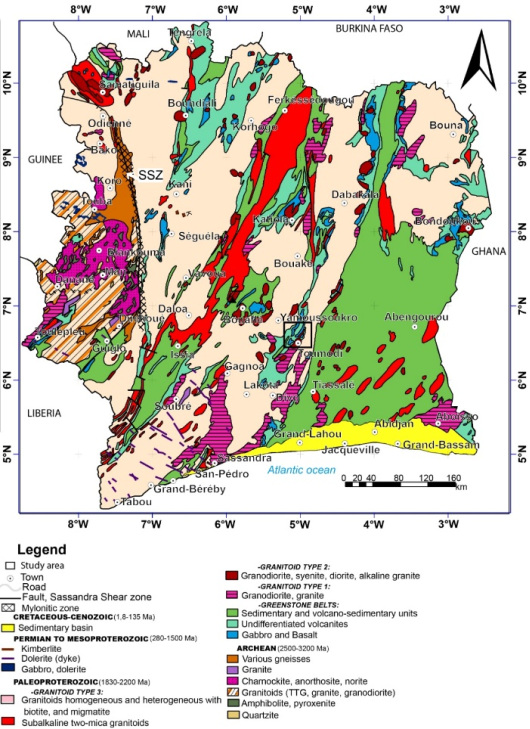
The Paleoproterozoic domain, located east of the Sassandra Fault, covers a larger area than the Archean, occupying 73% of the Ivorian territory (Figure 1). The formations of this domain occur as volcano sedimentary belts generally oriented NNE-SSW . These belts are bordered by or contain granitoid massifs that are widely distributed across the country. They consist of metavolcanics, gabbros, dolerites and pelitic formations. Their contents, interpreted by some authors as greenstone belts on the one hand and volcano sedimentary complexes on the other, are generally oriented NNE-SSW and flanked by granitoids. Seventeen Birimian belts, distributed along two principal alignments (reference lines), Tehini-Dimbokro (east) and Ferké-Soubré (central), have been identified in Côte d’Ivoire . These include the Odienné, Toulépleu, Guiglo, Soubré, Boundiali-Korhogo, Séguéla-W, Ferké and Katiola (Ferké-Marabadiassa area), Bouaflé (Yaouré area), Bouaké-E (Toumodi-Fettékro belt), Téhini (Upper Comoé area), Nassian-N, Bouna-SE, Bondoukou-N, Bondoukou, Dimbokro-Abengourou and Aboisso (Comoé area) belts. The Birimian lithostratigraphy defined in Ghana, which recognizes a Lower Birimian and an Upper Birimian overlain by the predominantly sedimentary Tarkwaian , was long (from 1945 to 1965) accepted and applied in Côte d’Ivoire . Earlier, prior to that period, had defined in Côte d’Ivoire a Lower paradermal Birimian series and an Upper plutono volcanic Birimian series. Subsequent studies led other authors to redefine the Birimian lithostratigraphy in Côte d’Ivoire. Thus, , then , opted to invert the Birimian succession proposed by in Ghana. They proposed a Lower Birimian of volcano sedimentary and volcanic affinity overlain by an Upper Birimian composed of flyschoid sediments. rejects the existence of the Tarkwaian in Côte d’Ivoire because, in his view, the conglomeratic series attributed to the Tarkwaian most often rest directly on the Lower Birimian. accepts the division into Lower and Upper Birimian but includes in the Lower Birimian formations previously considered Liberian in age. This study concerns only the southern part of the Toumodi-Fetekro belt, which is located in central Côte d’Ivoire. Improving the understanding of petrographic and structural characteristics is important because this belt has been the site of numerous mines. We limit this study to the Anikro hill.
2. Geological Context
The geological formations of Toumodi are part of the Birimian rocks structured by the Eburnean orogeny (Figure 1).
The first cartographic document for the Toumodi-Fetekro belt is the 1:500,000 Bouaké Ouest map published in 1943. It is the synthesis of surveys carried out by J. Archambault, L. Bouige and D. Bonnault from 1934 to 1938, between latitudes 6°00′ and 8°00′ N and longitudes 4°30′ and 6°00′ W. They reported the existence, over much of the belt, of a peneplain including low metamorphic formations (varied schists) resting on more metamorphosed units (quartzites, micaschists, para amphibolites and amphibolitic schists). This assemblage, overlain by Tarkwaian formations, contains lenses of acidic volcanic rocks (rhyolites and dacites), intermediate rocks (andesites) and basic rocks (basalts) as well as dolerites. , describing the northern part of the belt, emphasizes the basic character of the volcanism, the absence or near absence of pyroclastics and the abundance of pillow lavas, and correlates these rocks with ophiolites. The plutonic rocks are granodiorites, intrusive either discordant or concordant, and syn kinematic granites sometimes containing two micas. Metamorphism ranges from low to medium grade, the latter being more closely associated with the volcanics. Tectonically, the Birimian formations show a dominant NNE-SSW orientation. reports that the Toumodi-Fetekro formations belong to two volcanic sedimentary suites: the first consists of tholeiitic metabasites with an oceanic signature and pelitic metasediments that form greenstone belts. These greenstones are located near granitoid massifs that metamorphose them. The second suite comprises calc alkaline andesitic lavas, volcano sediments and sediments. This latter assemblage occupies a sedimentary basin that borders the belt and is intruded by granitoids. The Toumodi-Fetekro belt has significant mineral potential, mainly for gold. It hosts the Agbahou, Dougbafla, Bonikro, Blafo Guetto (Didiévi), Kokumbo deposits and the promising prospects at Bandama and Fetekro .
The Anikro Formation is composed of clastic metavolcanic rocks, with minor lava flows and volcanosedimentary sequences . The volcano sedimentary formations in this area include those of the Bomba River, which contain vesicular lavas with feldspar phenocrysts, flow breccias and epiclastic rocks. He interprets them as immature epiclastic rocks that display sedimentary structures such as cross bedding, consistent with deposition under shallow water. For this author, these conglomeratic formations would derive from erosion and subsequent deposition of locally derived volcanic material. According to , the conglomerates of the basin are volcanic conglomerates with cross bedding. The heterometric clasts are sometimes large, decimetric to metric, consisting of sub rounded to sub angular pebbles of andesitic to dacitic composition. These are typically mudflows that descended the flanks of an edifice destabilized by ash accumulation.
The conglomeratic formations of the Anikro region comprise pebbles of granitoids, quartz, bedded sediments, very few basic volcanoclastics and, predominately, banded felsic volcanites that are vacuolar or amygdaloidal, giving these formations a polygenic character . Primary stratification S0 predominates in the tuffaceous levels. The normal polarity—sometimes SE, sometimes NW, even NE—of these tuffaceous facies indicates that they post date the surrounding volcanic host rocks. Variation in dip directions—SE, NW and NE—reveals a synclinal structure where cross stratifications are observed. For this author, the characteristics of the conglomeratic formations indicate that the region’s volcanic activity was multi phased: highly explosive in subaerial and in shallow subaqueous settings. Folding occurred during the Eburnean tectono metamorphic event.
Figure 1. Geological map of Côte d’Ivoire, after , modified.
3. Materials and Methods
3.1. Petrography
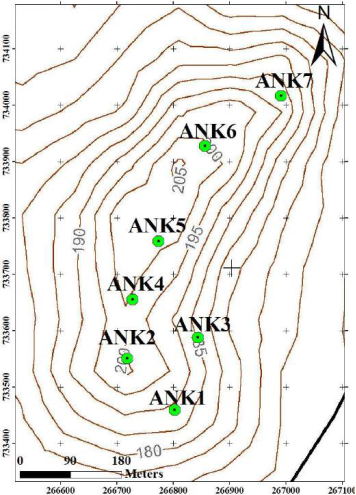
Macroscopic analysis concerns all architectural features visible to the naked eye, observed at various scales, from the mineralogical composition and the more or less oriented crystals within a rock to the major units (facies) of a continuous outcrop. Each outcrop is described according to a scheme that includes the shape of the outcrop, the structure, texture, mineralogical composition, colour, rock family, and degree of weathering. This approach made it possible to identify or, where possible, propose a name for the rock. Thin sections prepared in the Laboratory of Geology, Mineral and Energy Resources at Félix Houphouët Boigny University were examined using a polarizing microscope, first in plane polarized light and then in cross polarized light, and the mineral assemblages identified made it possible to corroborate the petrographic study carried out in the field. It also enabled us to characterize the different facies encountered in the study area. For this study, a total of seven (7) samples were collected (Figure 2).
Figure 2. Topographic map showing sampling points on the Anikro hill range.
3.2. Structural
Structural analysis consisted in making observations on the rocks, their deformation, and the structural elements (bedding, schistosity, fractures, folds and fold axes), as well as performing measurements for the study of deformation. The resulting structural data were exported as text files to the stereographic analysis software GEOrient, which enabled us to plot and visualise the directional rose diagram of the collected measurements.
4. Results
4.1. Petrography
The rocks observed in the study area are essentially magmatic rocks: plutonic, dyke rocks, and volcano-sedimentary rocks.
4.1.1. Plutonites
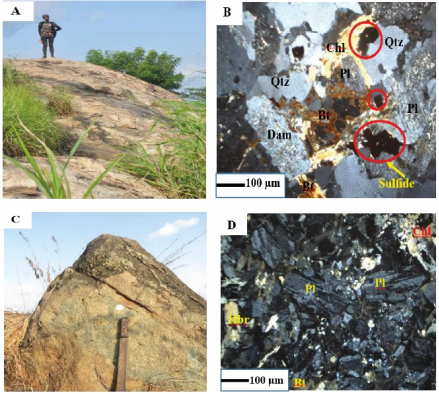
These are granite and diorite. The granite (Figure 3A) outcrops as a dome south of the Anikro hill chain; it is a massive, leucocratic rock. Minerals visible to the naked eye are quartz and slightly altered feldspar. The rock shows marked alteration, with reddish spots of iron oxides. With a coarse-grained (granular) texture, it also contains sericite, damourite, and chlorite, derived respectively from the alteration of plagioclases and biotite (Figure 3B). The diorite, in turn, outcrops to the northeast of the Anikro hill chain, interbedded with pyroclastic rocks. It is a massive, coarse-grained, melanocratic rock composed mainly of amphiboles (notably brown hornblende), plagioclases, and, as an accessory mineral, biotite, which progressively breaks down to chlorite (Figure 3C and D).
Bt: biotite; Pl: plagioclase; Hbr: Hornblende brune; Chl: chlorite; Dam: damourite; Qtz: quartz.

Download: Download full-size image

Figure 3. Macrophotographs and microphotographs of plutonic rocks (granite, diorite).
4.1.2. Dyke Rocks
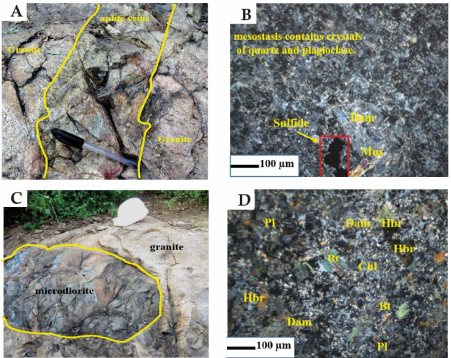
Bt: biotite; Pl: plagioclase; Hbr: Hornblende brune; Chl: chlorite; Dam: damourite; Qtz: quartz; Mus: muscovite.

Download: Download full-size image

Figure 4. Macrophotographs and microphotographs of dyke rocks (aplite, microdiorite).
These are essentially aplite and microdiorite. The aplite occurs as decimetric to metric dykes cutting across the granite (Figure 4A). Leucocratic in color and fine-grained in texture, the rock is massive and strongly altered, with iron oxides present. Under the microscope, it shows a quartzofeldspathic mesostasis and damourite derived from the alteration of plagioclases. Iron oxides represent the accessory phases of this lithology (Figure 4B). The microdiorite outcrops south of the hill chain, like the granite, and appears as an enclave within it (Figure 4C). It is a massive, melanocratic rock; grains are perceptible to the touch but not identifiable with the naked eye. Microscopic study revealed plagioclase, brown hornblende, and biotite. As secondary minerals, damourite and chlorite can be cited (Figure 4D).
4.1.3. Volcano-Sedimentary Rocks
The volcano-sedimentary rocks encountered on the Anikro hill chain display various textures and are generally greenish in color. They include volcanic breccias, tuffs, and cinerites.
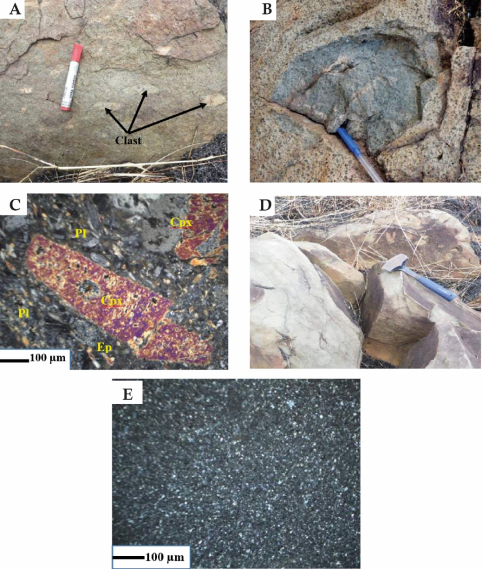
Volcanic breccias occur as large blocks and consist of centimeter-sized clasts embedded in a cement formed of ferromagnesian minerals. The clasts generally contain feldspar minerals and vary in shape and size. They are arranged without preferred orientation and appear predominantly angular (Figure 5A). Tuffs are generally observed on the hill slopes. Of medium grain size, the minerals that constitute them are on the order of a centimeter. They consist of pyroxene crystals in a ferromagnesian cement. In addition to these, plagioclases can also be cited, which progressively alter to epidotes (Figure 5B and C). As for cinerites, they outcrop at the foot of the hill chain. They have a hyaline texture, and their mineralogical composition consists of an aggregate of very small crystals embedded in a recrystallized mesostasis (Figure 5D and E).
Bt: biotite; Pl: plagioclase; Ep: epidote; Cpx: clinopyroxene.

Download: Download full-size image

Figure 5. Macrophotographs and microphotographs of volcano-sedimentary rocks (breccia, tuffs, cinerite).
4.2. Structural
The structures originate from either ductile or brittle deformation.
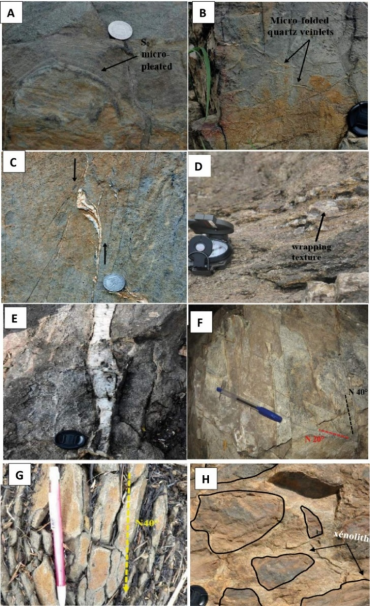
In the ductile regime, microfold structures are observed in the volcano-sedimentary formations and in the granitic pluton, generally along the stratification of quartz veins and veinlets (Figure 6A). These folds are generally asymmetric, indicating shearing (Figure 6C); some, however, reflect flexuring due to their symmetry (Figure 6B). Sinistral shear structures are also present in the cinerites, as well as rollover structures and pressure shadows in the granite (Figure 6D). The existence of post-flattening shearing is evidenced by boudinage oriented N10° (Figure 6E). As brittle deformation, two fracturing schistosity planes were observed (Figure 6F and G), localized in the microdiorite, granite, and aplite: an oblique schistosity plane oriented N20°, and a subvertical schistosity plane oriented N40°-80°SE. The cinerite is affected only by the N40° schistosity plane. Microdiorite xenoliths are also present (Figure 6H), resulting from deformation that occurred during the emplacement of the granitic pluton. These xenoliths were subsequently consolidated by a granitic cement (felsic magma) to form tectonic breccias. The angular shape of the xenoliths indicates the brittle nature of the deformation.
Figure 6. Photographs of deformation structures in the study area.
A: Microfolded stratification (S0); B: Microfolded quartz veinlet within cinerite; C: Quartz vein forming an S-shaped structure in cinerite; D: Rollover structure within granite; E: Boudinaged quartz dyke; F: Fracture schistosity in aplite; G: Fracture schistosity in cinerite; H: Tectonic breccia.
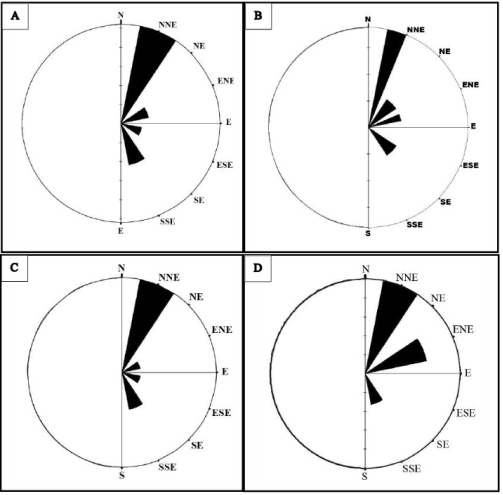
In addition, the geological formations of the Anikro hill are intensely fractured. Fracturing represents the major deformation experienced by the formations in the study area. To better understand the variations in fracture orientations in the study area, two directional rose diagrams were constructed to compare measurements taken on plutonic rocks and volcano-sedimentary rocks. A global fracturation rose diagram was also produced to highlight the overall fracture orientation in the area. The directional rose diagram obtained from fractures in plutonic rocks highlights a NNE direction, comprising fractures oriented N20° to N40°. To this direction is added a SSE direction (Figure 7A). The directional rose diagram of fractures in volcanic products highlights a NNE direction, which differs from that observed in the magmatic rocks. It is formed by fractures oriented N10° to N20°. To this direction are added ENE and SE directions (Figure 7B). The global fracture rose diagram shows a principal direction: NNE, formed by fractures from N10° to N40°. To these are added ENE and SSE directions (Figure 7C). The main dyke direction is NNE, with an additional ENE direction (Figure 7D).
Figure 7. Rosette diagrams of fracture and dyke orientations.
A: Rosette diagram of fracture orientations in plutonic and dyke rocks; B: Rosette diagram of fracture orientations in volcano-sedimentary rocks; C: Global fracture rose diagram of the Anikro hill chain; D: Rosette diagram of dyke orientations.
5. Discussion
5.1. Petro-Structural
The highlighted results show that the study area is dominated by magmatic rocks. These consist largely of a volcano-sedimentary complex composed of volcanic breccias, tuffs, and cinerites, together with plutonic rocks represented by granite and diorite, and finally dyke rocks such as microdiorite and aplite. The volcano-sedimentary formations are the result of a probable episode of explosive volcanism in the Anikro region. The Toumodi area is known to have experienced polyphase volcanic activity , including a highly explosive episode in subaerial and shallow subaqueous settings. The aplite and quartz veins cut across the granite and microdiorite, indicating that they are younger than these rocks. The granite is younger than the microdiorite, as it occurs as an enclave within it. These lithologies are consistent with the rock types that characterize the Birimian formations of the region . Indeed, this volcano-sedimentary complex, which forms the bulk of the geological basement of the study area, is affected by low-grade (epizonal) metamorphism of the greenschist facies. This Birimian rock complex is distinguished by a generally greenish coloration, due to recrystallized amphiboles, chlorites, sericites, and epidotes, as also noted by .
At Agbahou and at Bonikro also reported low-grade metamorphism, which locally reached the amphibolite facies, as in the Anikro locality.
From a structural point of view, the analysis revealed three (03) different deformation phases in the study area: bending, flattening, and simple shearing. Fracture schistosity, tectonic breccias, and fractures are structures generated by brittle tectonics. Bending, in turn, produced symmetrical micro-folds.
Two (02) shearing phases were also identified (a dextral shear and a sinistral shear), which generated fusiform and domino-shaped boudins, sinistral rotational structures, S-structures, and asymmetrical micro-folds. The presence of these various structures (shear-generated structures) could suggest the existence of a sinistral shear zone oriented N0° within the study area. These results are similar to those obtained by at the Bonikro deposit. The main NNE directions of fractures and veins observed at Anikro correspond to Birimian structural trends. In the Aféma and Angovia gold deposits, regional-scale shear zones of this type are present , indicating that the study area has potential for gold mineralization.
5.2. Model of the Emplacement of Geological Formations
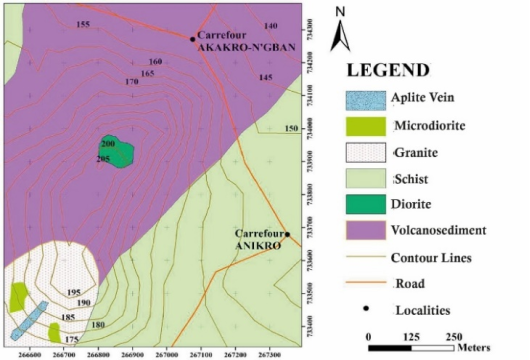
The available field data (petrographic and structural) make it possible to speculate on the different geological processes that contributed to the emplacement of the geological formations of the Anikro hill chain. First, we note an episode of basic magmatism expressed by both plutonism and volcanism. Plutonism generated basic rocks (diorite, microdiorite), while explosive volcanism led to the formation of volcano-sedimentary rocks (breccias, tuffs and cinerites). Then, we have a second episode of felsic magmatism, marked by the emplacement of a granitic pluton intruding into the pre-existing formations. This intrusion is responsible for the low-grade metamorphism affecting these formations. The emplacement of the granitic pluton is accompanied by brittle tectonics, which resulted in the formation of tectonic breccias within the microdiorite occurring as enclaves in the granite. Finally, all these formations are affected by a general flattening and shearing. This succession of geological events in the Anikro hill chain is quite similar to the succession of geological events that led to the emplacement of geological formations in the Kokumbo area. However, it is somewhat different from the succession of geological events that controlled the emplacement of geological formations in the Bonikro gold deposit. The petrographic and structural results obtained have enabled us to propose a geological map of the study area at a scale of 1:5,000 (Figure 8).
Figure 8. Geological map of the Anikro hill at 1/5000; ; modified.
6. Conclusions
At the end of this study, we were able to highlight the petrographic and structural characteristics associated with the geological formations of the Anikro hill chain, located in the Oumé-Fettèkro greenstone belt, Côte d’Ivoire, and to propose a model for the emplacement of these different formations. Indeed, field data combined with thin-section analysis show that the petrographic formations in the study area are exclusively magmatic rocks: volcano-sedimentary rocks (volcanic breccia, tuff and cinerite), plutonic rocks (granite, diorite) and vein rocks (aplite and microdiorite). The granitic pluton intrudes into the pre-existing formations and is therefore the youngest formation of the hill chain. These formations are weakly metamorphosed as a result of this intrusion and evolve within the greenschist facies. From a structural point of view, two deformation mechanisms are observed: flattening and shearing, preceded by brittle tectonics. Overall, the fracture rose diagram shows a main orientation. The dominant NNE trend is formed by the fractures. In addition to this main trend, ENE and SSE orientations are also observed. The veins in the area are likewise generally oriented NNE.
Abbreviations

NNE

North-Northeast

ENE

East-Northeast

SSE

South-Southwest

Acknowledgments
I wish to express my deep gratitude to Laboratory of Geology, Mineral and Energy Resources, Félix Houphouët-Boigny University, Abidjan, Côte d’Ivoire for their assistance in the preparation and observation of thin sections, which provided an indispensable basis for the petrographic analysis of the Anikro hill chain.
Author Contributions
Brice Roland Kouassi: Conceptualization, Data curation, Formal Analysis, Investigation, Methodology, Software, Validation, Writing – original draft, Writing – review & editing
Yao Honore Koffi: Conceptualization, Data curation, Formal Analysis, Investigation, Methodology, Software, Validation, Writing – original draft, Writing – review & editing
Kouadio David Koffi: Conceptualization, Data curation, Formal Analysis, Investigation, Methodology, Software, Validation, Writing – original draft, Writing – review & editing
Conflicts of Interest
The authors declare no conflicts of interest.
References
[1] Arnould A. Etude géologique des migmatites et des granites précambriens du NE de la Côte d'Ivoire et de la Haute Volta méridionale. Doctorat, Clennont Ferrand, Mém. BRGM, Fr., n° 3, 1961. 174 p.
[2] Bonhomme M. Contribution à l’étude géochronologique de la plate- forme de l’Ouest africain. Ann. Fac. Sc. Université. Clermont-Ferrand, n°5, 1962. 62 p.
[3] Tagini B. Esquisse structurale de la Côte d’Ivoire. Essai géotechnique régional. Doctorat, Université. Lausannne (Suisse) Fac. Des Sciences et SODEMI, Abidjan, 1971. 302 p.
[4] Pothin K. B. K. Pétrographie et géochimie des formations précambriennes de la région d’Odienné (Nord-Ouest de la Côte d’Ivoire). Typologie du volcanisme birimien. Tendances évolutives du magmatisme éburnéen. Géochimie de l’Uranium et du Thorium dans les granitoïdes. Doctorat d’Etat, ès Sciences Naturelles, Université d’Abidjan, Côte d’Ivoire, 1988. 329 p.
[5] Daouda Y. B. Lithostratigraphie et pétrologie des formations birimiennes de Toumodi-Fettêkro, Côte d’Ivoire: implication pour l’évolution crustale du Paléo protérozoïque du craton Ouest-Africain. Doctorat, Université. Orléans-Géosciences, Mémoire 737, 1998. 191 p.
[6] Yace I. Initiation à la géologie. L’exemple de la Côte d’Ivoire et de l’Afrique de l’Ouest (Pétrologie et Géologie régional). Edition CEDA, Abidjan, Côte d’Ivoire, 2002. 183 p.
[7] Junner N. R. Provincial geological map of the gold coast and western togoland. Cold Coast Geol. Surv., Bull., n°11, 1940. 40 p.
[8] Arnould G. Les ressources minières de l’Afrique Occidentale. Bull. Dir. des Mines A. O. F., Dakar, n°8, 1945. 100 p.
[9] Roques M. Le Précambrien de l’Afrique Occidentale Française. Bull. Soc. Géol. Fr., 5e Série, t. XVIII, fasc. 8-9, Paris, 1948. pp. 589-628.
[10] Archambault J., Bouige L. et Bonnault D. Carte géologique de reconnaissance de l’A. O. F. à l’échelle du 1/500 000 et notice explicative feuille Abidjan Ouest. Serv. des Mines. A. O. F., Dakar, 1943. 30 p.
[11] Bagarre E. et Tagini B. Carte géologique de la Côte d’Ivoire au 1/1.000.000. SODEMI / DMG Abidjan, Côte d’Ivoire, 1965. 1 p.
[12] Bard J. P. Remarque à propos de l’évolution géotectonique du craton Ouest Africain en Côte d’Ivoire. C. R. Acad. Sc. Paris, t. 278, Série D, 1974. pp. 2405-2408.
[13] Vitali G. Contribution à l’étude géologique du Birimien. Stratigraphie et structure du complexe volcano-sédimentaire de Fettekro (Côte d’Ivoire). Note BRGM, 1970. 26 p.
[14] Gnanzou A. Etude des séries volcanosédimentaires de la région de Dabakala (Nord-Est de la Côte d’Ivoire): Genèse et évolution magmatique. Contribution à la connaissance de la minéralisation aurifère de Bobosso dans la série de la Haute-Comoé. Doctorat, Université PARIS-SUD XI, France et Université Félix HOUPHOUET-BOIGNY, Abidjan, Côte d’Ivoire, 2014. 303 p.
[15] Houssou N. N. Etude pétrographique, structurale et métallogénique du gisement aurifère d’Agbahou, Divo, Côte d’Ivoire. Doctorat, Université. Félix HOUPHOUET BOIGNY, Abidjan, Côte d’Ivoire, 2013. 177 p.
[16] Mortimer J. Evolution of the early Proterozoïc Toumodi Volcanic Group and associated rocks, Ivory Coast. Ph D. Thesis CNAA. Portsmouth Polytech. Portsmouth, 1990. 244 p.
[17] Okou A. Pétrographie et origine des formations conglomératiques d’Anikro. Mémoire de cycle ingénieur, 2005. 32 p.
[18] Coulibaly I. Pétrologie des volcanites et des plutonites du sud du sillon birimien de Toumodi-Fetekro (Côte d’Ivoire): Implications pétrogénétique et tectonique. Doctorat, Univ. Felix Houphouët -Boigny, 2018. 220 p.
[19] Yace I. Etude géologique du volcanisme éburnéen dans les parties centrales et méridionales de la chaîne précambrienne de Fettékro. Bull. Dir. Géol. Abidjan, 1982. 155 p.
[20] Ouattara Z. Caractères lithostratigraphiqies, structural, géochimique et métallogénique du gisement d’or de Bonikro, sillon birimien de Fettekro, centre-sud de la Côte d’Ivoire. Doctorat, Université Félix HOUPHOUET-BOIGNY, Abidjan, Côte d’Ivoire, 2015. 256 p.
[21] Ouattara Z., Coulibaly Y. et Lieben F. Pétrographie du gisement d’or de Bonikro, sillon birimien d’Oumé-Fettèkro, Côte d’Ivoire. European Scientific Journal, Vol, 11, n°21, 2015. pp. 119 - 132.
[22] Assie K. E. Lode gold mineralization in the Paleoproterozoic (Birimian) volcano- sedimentary sequence of Afema gold district, southeastern Côte d’Ivoire. Thesis, Faculty of Energy and Economic Sciences. Technical University of Clausthal, Germany, 2008. 198p.
[23] Coulibaly Y., Boiron M. C., Cathelineau M. and Kouamelan A. N. Fluid immiscibility and gold deposition in the Birimian quartz veins of the Angovia deposit (Yaouré, Ivory Coast). Journal of African Earth Sciences 50, 2008. pp. 234-254.
[24] Wille S. E. and Klemd R. Fluid inclusion studies of the Abawso gold prospect, near the Ashanti Belt, Ghana. Mineralium Deposita 39, 2004. pp. 31-45.
[25] Yace I. Le volcanisme éburnéen dans les parties centrales et méridionales de la chaîne précambrienne de Fettékro en Côte d’Ivoire. Doctorat d’Etat, ès Sci. Universitéersité d’Abidjan, Côte d’Ivoire, 1976. 373 p.
Cite This Article
  • APA Style

    Kouassi, B. R., Koffi, Y. H., Koffi, K. D., Allialy, M. E. (2026). Crustal Evolution of the Southern Part of the Toumodi-Fetekro Belt: Petro-Structural Study of the Geological Formations of Anikro Hill (Côte d’Ivoire, WAC). Earth Sciences, 15(4), 205-215. https://doi.org/10.11648/j.earth.20261504.15

    Copy | Download

    ACS Style

    Kouassi, B. R.; Koffi, Y. H.; Koffi, K. D.; Allialy, M. E. Crustal Evolution of the Southern Part of the Toumodi-Fetekro Belt: Petro-Structural Study of the Geological Formations of Anikro Hill (Côte d’Ivoire, WAC). Earth Sci. 2026, 15(4), 205-215. doi: 10.11648/j.earth.20261504.15

    Copy | Download

    AMA Style

    Kouassi BR, Koffi YH, Koffi KD, Allialy ME. Crustal Evolution of the Southern Part of the Toumodi-Fetekro Belt: Petro-Structural Study of the Geological Formations of Anikro Hill (Côte d’Ivoire, WAC). Earth Sci. 2026;15(4):205-215. doi: 10.11648/j.earth.20261504.15

    Copy | Download

  • @article{10.11648/j.earth.20261504.15,
      author = {Brice Roland Kouassi and Yao Honore Koffi and Kouadio David Koffi and Marc Ephrem Allialy},
      title = {Crustal Evolution of the Southern Part of the 
    Toumodi-Fetekro Belt: Petro-Structural Study of the Geological Formations of Anikro Hill (Côte d’Ivoire, WAC)},
      journal = {Earth Sciences},
      volume = {15},
      number = {4},
      pages = {205-215},
      doi = {10.11648/j.earth.20261504.15},
      url = {https://doi.org/10.11648/j.earth.20261504.15},
      eprint = {https://article.sciencepublishinggroup.com/pdf/10.11648.j.earth.20261504.15},
      abstract = {The Anikro hill chain is located in the southern part of the Toumodi–Fetekro greenstone belt, specifically northeast of Anikro village. This study aims to improve the understanding of the petrography, structural geology, and associated mineralization of the Anikro hill chain. To achieve this objective, a petro-structural investigation of the different geological formations was carried out. Field observations combined with petrographic examination under the microscope enabled the identification and characterization of the various mineral parageneses. The brittle and ductile deformation structures recognized in the field were used to construct rosette diagrams in order to determine the principal structural trends. The lithologies identified in the Anikro area are exclusively igneous rocks, including plutonic rocks (granite and diorite), dykes rocks (microdiorite and aplite), and volcanosedimentary rocks (cinerite, tuff, and volcanic breccia). The diorite, microdiorite, and volcanosedimentary rocks originated from basic magmatism and were subsequently intruded by a granitic pluton derived from late-stage acidic magmatism. These rock units were affected by low-grade metamorphism corresponding to the greenschist facies. Structurally, three deformation mechanisms were identified: brittle deformation, folding, and shearing. The dominant fracture orientation within the study area is NNE.},
     year = {2026}
    }
    

    Copy | Download

  • TY  - JOUR
    T1  - Crustal Evolution of the Southern Part of the 
    Toumodi-Fetekro Belt: Petro-Structural Study of the Geological Formations of Anikro Hill (Côte d’Ivoire, WAC)
    AU  - Brice Roland Kouassi
    AU  - Yao Honore Koffi
    AU  - Kouadio David Koffi
    AU  - Marc Ephrem Allialy
    Y1  - 2026/08/22
    PY  - 2026
    N1  - https://doi.org/10.11648/j.earth.20261504.15
    DO  - 10.11648/j.earth.20261504.15
    T2  - Earth Sciences
    JF  - Earth Sciences
    JO  - Earth Sciences
    SP  - 205
    EP  - 215
    PB  - Science Publishing Group
    SN  - 2328-5982
    UR  - https://doi.org/10.11648/j.earth.20261504.15
    AB  - The Anikro hill chain is located in the southern part of the Toumodi–Fetekro greenstone belt, specifically northeast of Anikro village. This study aims to improve the understanding of the petrography, structural geology, and associated mineralization of the Anikro hill chain. To achieve this objective, a petro-structural investigation of the different geological formations was carried out. Field observations combined with petrographic examination under the microscope enabled the identification and characterization of the various mineral parageneses. The brittle and ductile deformation structures recognized in the field were used to construct rosette diagrams in order to determine the principal structural trends. The lithologies identified in the Anikro area are exclusively igneous rocks, including plutonic rocks (granite and diorite), dykes rocks (microdiorite and aplite), and volcanosedimentary rocks (cinerite, tuff, and volcanic breccia). The diorite, microdiorite, and volcanosedimentary rocks originated from basic magmatism and were subsequently intruded by a granitic pluton derived from late-stage acidic magmatism. These rock units were affected by low-grade metamorphism corresponding to the greenschist facies. Structurally, three deformation mechanisms were identified: brittle deformation, folding, and shearing. The dominant fracture orientation within the study area is NNE.
    VL  - 15
    IS  - 4
    ER  - 

    Copy | Download

Author Information
  • UFR-Biological Sciences & Geosciences Department, Peleforo Gon Coulibaly University, Korhogo, Cote d’Ivoire
  • UFR-Biological Sciences & Geosciences Department, Peleforo Gon Coulibaly University, Korhogo, Cote d’Ivoire

  • Laboratory of Geology & Mineral and Energy Resources, Felix Houphouët-Boigny University, Abidjan, Cote d’Ivoire

  • Laboratory of Geology & Mineral and Energy Resources, Felix Houphouët-Boigny University, Abidjan, Cote d’Ivoire