
In this scientific paper, the author provides a detailed analysis of using various Remote Sensing applications, from Image Processing to Visualisation using ArcGIS Pro (Included with Storytelling). The research paper has been formed during the last three years, during individual research and advocacy. To provide a summary, the authors travelled and represented in different kinds of tech conferences. The paper creates a value in the new space economy, by representing one of the latest tools used by researchers. However there are plenty of great GIS tools, the author used ArcGIS for this research. The purpose and significance of the study are relevant in today's geospatial challenges and accessibility of data usage, the research method made by individual decision, well detailed data analysis and image acquisition. The article can be a great start to engage the public audience and to understand the real work behind each space data image. The author warmly recommends the paper for every science interested person. General overview of the study area, 3 USG Landsat images, and one EO-1 Hyperion image, processing, extraction, and visualization using ArcGIS Pro. Our method used open source data for research, where we primarily examined the quality of the images, processing them as a single image rather than using large ML/AI-driven algorithms. We did not use a large dataset because our resources were not capable of handling that amount of data. However, the results can be derived from more accurate and detailed images based on the title, description, and agricultural solutions (in this case). In this study, we present and examine images from four different time points and created using different RGB methods.
| Published in | Earth Sciences (Volume 15, Issue 3) |
| DOI | 10.11648/j.earth.20261503.13 |
| Page(s) | 158-162 |
| Creative Commons |
This is an Open Access article, distributed under the terms of the Creative Commons Attribution 4.0 International License (http://creativecommons.org/licenses/by/4.0/), which permits unrestricted use, distribution and reproduction in any medium or format, provided the original work is properly cited. |
| Copyright |
Copyright © The Author(s), 2026. Published by Science Publishing Group |
Landsat, ArcGIS Pro, Earth Observation, Remote Sensing, Land Monitoring, Water Resource Management, LLDs (Landlocked Developing Countries)
EO | Earth Observation |
RS | Remote Sensing |
GIS | Geospatial Information Systems |
LLDCs | Landlocked Developing Countries |
WiS | Women in Science |
STEM | Science, Technology, Education, Mathematics |
USG | US Geological Survey |
EO-1 | Earth Observing 1 (NASA Started in 2000) |
NASA | National Aeronautics and Space Administration |
| [1] | Juan Torres-Batlló, Belen Marti-Cardona The conservation, Why Bolivia's second largest lake disappeared and how to bring it back. January 11, 2021 5.36pm CET |
| [2] |
Giulio Aprin, 2026, The Eye of the sahara geology guelb er richat
https://www.wildmanlife.com/eye-of-the-sahara-geology-guelb-er-richat/ |
| [3] | Richat Structure, wikipedia: |
| [4] |
Multispectral data source: Landsat data access:
https://www.usgs.gov/landsat-missions/landsat-data-access U.S. Geological Survey Creative common. |
| [5] | EO Portal, Earth Observing 1, 2023 |
| [6] |
Hyperspectral data source: USGS EROS Archive - Earth Observing One (EO-1) - Hyperion
https://www.usgs.gov/centers/eros/science/usgs-eros-archive-earth-observing-one-eo-1-hyperion |
| [7] | Women Tech Network, What challenge women face in geospatial data careers and how can they overcome them, (unknown year) |
| [8] | Ocean science in action, empowering women for a sustainable ocean future, 2023 |
| [9] | Landlocked country, (44 LL country): wikipedia |
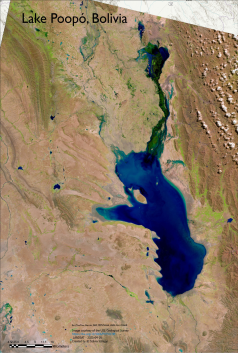
| [10] | Lake Popoo, 2025 Image creator: Szilvia Szilagyi 2025 April Using ESRI Personal user licence |
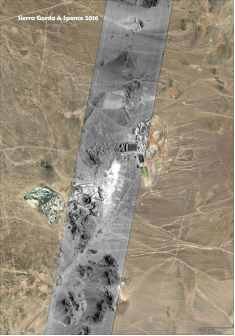
| [11] | Sierra Gorda and Spence 2016, Image creator: Szilvia Szilagyi 2024, Aug 9. Using ESRI Personal user licence. |
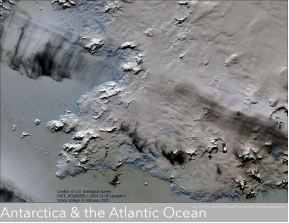
| [12] | Antarctica and Oceania, 2024, Image creator: Szilvia Szilagyi 2025. ESRI Personal user. |
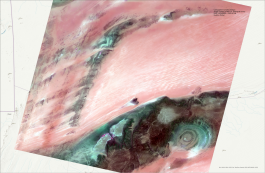
| [13] | Guelb er Richat 2025, Image creator Szilvia Szilagyi, using ESRI Personal licence user. |
| [14] |
Matt Collins, Geo Week, Younger Geospatial professionals discuss the next generation of industry insiders, 2023
https://www.geoweeknews.com/blogs/younger-geospatial-professionals-award-diversity-next-generatio |
| [15] | Climate Science Special Report: Fourth National Climate Assessment, Volume I, Personal Author(s): Wuebbles, Donald J.; Fahey, David W.; Hibbard, Kathy A. Corporate Authors(s): U.S. Global Change Research Program; National Oceanic and Atmospheric Administration; National Aeronuatics and Space Administration; 2017, Series: U.S. National Climate Assessment, |
| [16] |
D. P. Roy a, V. Kovalskyy a, H. K. Zhang a, E. F. Vermote b, L. Yan a, S. S. Kumar a, A. Egorov Remote sensing Environment, 2016, Characterization of Landsat-7 to Landsat-8 reflective wavelength and normalized difference vegetation index continuity,
https://www.sciencedirect.com/science/article/pii/S0034425715302455 |
| [17] | Earth Observing One (EO-1) - Hyperion Digital Object Identifier |
| [18] | Land Cover Changes based on Landsat imagery, 2023 |
APA Style
Szilagyi, S. (2026). Multispectral and Hyperspectral Remote Sensing, from Image Processing to Visualisation Using ArcGIS Pro. Earth Sciences, 15(3), 158-162. https://doi.org/10.11648/j.earth.20261503.13
ACS Style
Szilagyi, S. Multispectral and Hyperspectral Remote Sensing, from Image Processing to Visualisation Using ArcGIS Pro. Earth Sci. 2026, 15(3), 158-162. doi: 10.11648/j.earth.20261503.13
@article{10.11648/j.earth.20261503.13,
  author = {Szilvia Szilagyi},
  title = {Multispectral and Hyperspectral Remote Sensing, from Image Processing to Visualisation Using ArcGIS Pro},
  journal = {Earth Sciences},
  volume = {15},
  number = {3},
  pages = {158-162},
  doi = {10.11648/j.earth.20261503.13},
  url = {https://doi.org/10.11648/j.earth.20261503.13},
  eprint = {https://article.sciencepublishinggroup.com/pdf/10.11648.j.earth.20261503.13},
  abstract = {In this scientific paper, the author provides a detailed analysis of using various Remote Sensing applications, from Image Processing to Visualisation using ArcGIS Pro (Included with Storytelling). The research paper has been formed during the last three years, during individual research and advocacy. To provide a summary, the authors travelled and represented in different kinds of tech conferences. The paper creates a value in the new space economy, by representing one of the latest tools used by researchers. However there are plenty of great GIS tools, the author used ArcGIS for this research. The purpose and significance of the study are relevant in today's geospatial challenges and accessibility of data usage, the research method made by individual decision, well detailed data analysis and image acquisition. The article can be a great start to engage the public audience and to understand the real work behind each space data image. The author warmly recommends the paper for every science interested person. General overview of the study area, 3 USG Landsat images, and one EO-1 Hyperion image, processing, extraction, and visualization using ArcGIS Pro. Our method used open source data for research, where we primarily examined the quality of the images, processing them as a single image rather than using large ML/AI-driven algorithms. We did not use a large dataset because our resources were not capable of handling that amount of data. However, the results can be derived from more accurate and detailed images based on the title, description, and agricultural solutions (in this case). In this study, we present and examine images from four different time points and created using different RGB methods.},
 year = {2026}
}
TY  - JOUR
T1  - Multispectral and Hyperspectral Remote Sensing, from Image Processing to Visualisation Using ArcGIS Pro
AU  - Szilvia Szilagyi
Y1  - 2026/06/27
PY  - 2026
N1  - https://doi.org/10.11648/j.earth.20261503.13
DO  - 10.11648/j.earth.20261503.13
T2  - Earth Sciences
JF  - Earth Sciences
JO  - Earth Sciences
SP  - 158
EP  - 162
PB  - Science Publishing Group
SN  - 2328-5982
UR  - https://doi.org/10.11648/j.earth.20261503.13
AB  - In this scientific paper, the author provides a detailed analysis of using various Remote Sensing applications, from Image Processing to Visualisation using ArcGIS Pro (Included with Storytelling). The research paper has been formed during the last three years, during individual research and advocacy. To provide a summary, the authors travelled and represented in different kinds of tech conferences. The paper creates a value in the new space economy, by representing one of the latest tools used by researchers. However there are plenty of great GIS tools, the author used ArcGIS for this research. The purpose and significance of the study are relevant in today's geospatial challenges and accessibility of data usage, the research method made by individual decision, well detailed data analysis and image acquisition. The article can be a great start to engage the public audience and to understand the real work behind each space data image. The author warmly recommends the paper for every science interested person. General overview of the study area, 3 USG Landsat images, and one EO-1 Hyperion image, processing, extraction, and visualization using ArcGIS Pro. Our method used open source data for research, where we primarily examined the quality of the images, processing them as a single image rather than using large ML/AI-driven algorithms. We did not use a large dataset because our resources were not capable of handling that amount of data. However, the results can be derived from more accurate and detailed images based on the title, description, and agricultural solutions (in this case). In this study, we present and examine images from four different time points and created using different RGB methods.
VL  - 15
IS  - 3
ER  -
Independent Scholar, Warsaw, Poland
Biography: Szilvia Szilagyi Early career ocean scientist, storyteller and geographer Previously 2x Founder wspace36 (previously Drone Design Lab, 2022GIS advocate for equal GIS consultancy) ERC participant in 2024.

Information



 Share This Article
 Twitter
 Linked In
 Facebook
 Copy
Copy Download