Abstract
Utilizing 2D and 3D seismic data, a large-scale detachment thrust structure within the Lower Paleozoic Ordovician Majiagou Formation (O1m) has been identified west of Lishi in the eastern Ordos Basin. This study investigates the structural characteristics, spatial distribution, evolutionary stages, and exploration potential of this structure. The results indicate: (1) The Lower Paleozoic Lishi West Detachment Thrust Belt (DTB) in the eastern Ordos Basin margin is 5–10km wide, extends nearly north-south parallel to the Lishi Fault Zone, and has considerable strike length. (2) The main faults of the Lishi West DTB initiated in the Precambrian and subsequently underwent four major evolutionary stages: stable sedimentation in the Ordovician epicontinental sea; formation of the detachment thrust belt from the Late Ordovician to Late Carboniferous; stable sedimentation from the Late Carboniferous to Middle Jurassic; and compressional uplift from the Middle Jurassic to Cretaceous. (3) The Lishi West DTB originated during the Caledonian period as a deep-seated structural weak zone. During the Yanshanian period, the eastern basin margin experienced westward compression, leading to regional tilting and uplift. Stress release along this pre-existing weak zone caused significant variations in formation dip angles and fault characteristics across the belt. This DTB is interpreted as the boundary separating the Jinxi Warp-Fold Belt and the Yishan Slope. (4) The detachment thrust belt in the eastern margin plays a critical role in hydrocarbon accumulation and subsequent migration/readjustment. The area west of the belt is favorable for exploring various coal-measure hydrocarbon resources, including deep coalbed methane (CBM) and in-source to near-source tight gas. A series of positive structural traps with large aerial extent have developed within the O1m Formation along the Lishi West DTB, demonstrating high exploration potential.
|
Published in
|
Earth Sciences (Volume 15, Issue 1)
|
|
DOI
|
10.11648/j.earth.20261501.11
|
|
Page(s)
|
1-9 |
|
Creative Commons
|

This is an Open Access article, distributed under the terms of the Creative Commons Attribution 4.0 International License (http://creativecommons.org/licenses/by/4.0/), which permits unrestricted use, distribution and reproduction in any medium or format, provided the original work is properly cited.
|
|
Copyright
|
Copyright © The Author(s), 2026. Published by Science Publishing Group
|
Keywords
Eastern Ordos Basin, Lower Paleozoic, Shiloubei Area, Detachment Thrust Structure, Structural Evolution,
Hydrocarbon Accumulation
1. Introduction
The Ordos Basin, developed upon the North China Cratonic platform, constitutes a large-scale intracratonic superimposed basin and ranks as China’s second-largest sedimentary basin. It comprises six first-order tectonic units: the Yimeng Uplift, Weibei Uplift, Jinxi Warp-Fold Belt, Shanbei Slope, Tianhuan Depression, and Western Thrust Belt. Enriched with abundant energy minerals, it currently serves as China’s largest oil and gas production base. In recent years, intensified exploration has led to discoveries of tight gas, deep coalbed methane (CBM), and shale gas reservoirs in the eastern Ordos Basin, including the Daning-Jixian, Shilouxi, Linxing-Shenfu, and Yanchuannan fields, underscoring significant resource potential in coal-measure gas plays
| [1] | XU F Y, HOU W, XIONG X Y, et al. Current status and development strategy of China's coalbed methane industry [J/OL]. Petroleum Exploration and Development: 1-14 (2023-07-20). |
| [2] | CAI Y D, GAO G S, LIU D M, et al. Geological conditions and accumulation models of coal-measure gas in Linxing central area, eastern Ordos Basin [J]. Natural Gas Industry, 2022, 42(11): 25-36. |
| [3] | YAO H S, CHEN Z L, HE X P, et al. "Effective proppant support" concept and innovative practice in deep CBM development: Case study of Yanchuannan CBM field, Ordos Basin [J]. Natural Gas Industry, 2022, 42(06): 97-106. |
[1-3]
.
While exploration continues to yield successes in Upper Paleozoic coal-measure gas, focus has progressively shifted to the Lower Paleozoic. Lower Paleozoic gas reservoirs in the Ordos Basin are categorized into two domains: 1. Weathering crust reservoirs near the Ordovician top unconformity, exemplified by the karst platform gas field in the Majiagou Formation (O
1m) at Jingbian, along with breakthroughs in the karst slope areas of O₁m in regions such as Yulin–Mizhi
| [4] | YANG H, FU J H, WEI X S, et al. Natural gas exploration domains in Ordovician marine carbonates, Ordos Basin [J]. Acta Petrolei Sinica, 2011, 32(05): 733-740. |
| [5] | XIE K, TAN X C, FENG M, et al. Early diagenetic karstification and reservoir-controlling effects in Majiagou Formation (Ordovician), eastern Sulige gas field, Ordos Basin [J]. Petroleum Exploration and Development, 2020, 47(06): 1159-1173. |
| [6] | WANG Y N, REN J F, YANG W J, et al. Gas accumulation characteristics and exploration potential of Majiagou Formation in central-eastern Ordos Basin [J]. Marine Origin Petroleum Geology, 2015, 20(04): 29-37. |
[4-6]
. 2. Subsalt and deep exploration within the Ordovician Majiagou Formation. Exploration in this domain remains exploratory. In 2021, Well MT1, deployed in the Shenmu–Mizhi area, yielded high industrial gas flow from the M4 Member, further confirming substantial exploration potential
| [7] | HE H Q, GUO X J, ZHAO Z Y, et al. New insights into gas accumulation and major exploration breakthrough in subsalt M4 member of Ordovician, Ordos Basin [J]. Petroleum Exploration and Development, 2022, 49(03): 429-439. |
| [8] | FU J H, YU Z, LI C S, et al. New discovery and exploration direction of Ordovician M4 member gas in Well Mitan 1, eastern Ordos Basin [J]. Natural Gas Industry, 2021, 41(12): 17-27. |
[7, 8]
.
Recently, integrated analysis of 3D seismic data from the Shiloubei Block and 2D seismic data from the eastern Ordos Basin has identified a submeridional-trending detachment thrust belt within the Lower Paleozoic succession. This study systematically investigates the structural characteristics, spatial distribution, and evolutionary history of this thrust belt, evaluates its geological significance and hydrocarbon exploration potential, thereby advancing regional structural understanding and providing a scientific foundation for Lower Paleozoic exploration in the eastern Ordos Basin margin.
2. Geological Setting
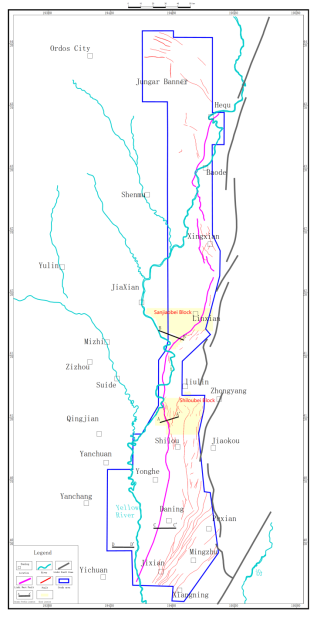
The study area is located in the eastern Ordos Basin (
Figure 1), straddling two major tectonic units: the Jinxi Warp-Fold Belt and the Yishan Slope. Stratigraphic uplift intensifies progressively eastward, accompanied by increasingly intense structural deformation. Well data confirm the presence of the Proterozoic Changcheng System, Cambrian System, Ordovician Yeli, Liangjiashan, and Majiagou formation, Carboniferous Benxi Formation, Permian Taiyuan Formation, Shihezi Formation, and Shiqianfeng Formation, and Triassic Liujiagou Formation, Heshanggou Formation, Zhifang Formation, and Yanchang formation.
The Shiloubei Block lies along the eastern Ordos Basin margin. It adjoins the Liulin Block and Mizhi Gas Field to the north, borders the Shilouxi Block to the south, abuts the Lüliang Mountains to the east, and neighbors the Zizhou-Qingjian Block to the west. The block exhibits a SW-dipping monoclinal structure, with steeper dips and developed faults in the east, transitioning to gentler dips and reduced faulting in the southwest. Previous exploration targeting Upper Paleozoic coalbed methane (CBM) and tight gas relied primarily on 2D seismic data. In 2020, 3D seismic acquisition significantly enhanced data resolution.
Figure 1. Structural Outline Map of the Lower Paleozoic in the Eastern Ordos Basin Margin.
Integrated interpretation of 2D and 3D seismic data from the eastern Ordos Basin has identified a salt-crumpling-related detachment thrust structure within the Lower Paleozoic Ordovician Majiagou Formation (O₁m). This structural belt, extending submeridionally parallel to the Lishi Fault Zone, is formally designated as the Lishi West Detachment Thrust Belt (DTB). As a regionally extensive feature exhibiting episodic activity from the Precambrian to present, this thrust belt holds significant geological implications and hydrocarbon exploration value.
3. Structural Characteristics and Evolution
3.1. Structural Geometry and Distribution
3D seismic data from the Shiloubei Block (
Figure 2; profile locations in
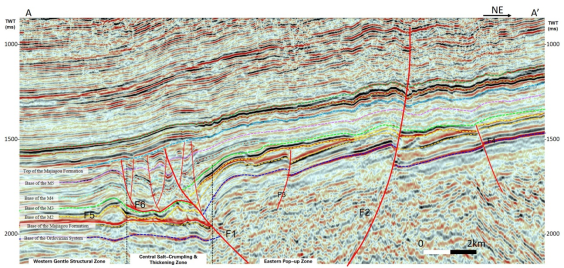
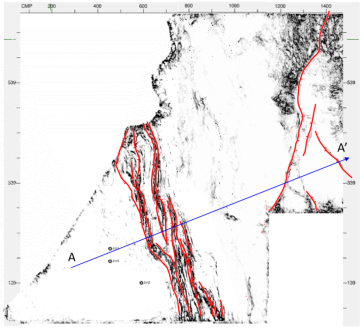
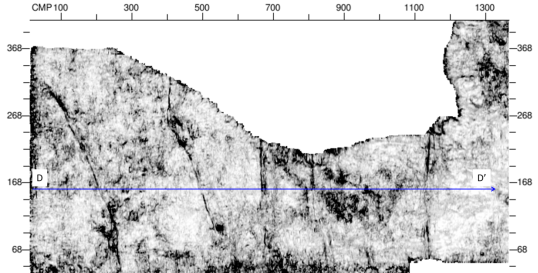
Figures 1 & 3) reveal that the Lishi West Detachment Thrust Belt (DTB) is dominated by gypsum-salt crumpling and features three genetically associated fault types: thrust faults, detachment faults, and salt-crumpling compression faults. The thrust fault system (F1–F4) comprises reverse faults with submeridional strikes, of which F1 and F2 originated during the Meso-Neoproterozoic as boundary faults for local depressions. Seismic profiles demonstrate these faults penetrate downward through the Meso-Neoproterozoic basement with >100 m vertical displacement in the Lower Paleozoic, while exhibiting differential upward propagation: F2 extends into the Triassic with significantly reduced displacement (<100 m) in Upper Paleozoic-Mesozoic strata, whereas F1 terminates within the Lower Paleozoic succession. Detachment faults (F5–F6), located at the bases of the Majiagou Formation Members O₁m₁ and O₁m₃, display pronounced ductile flow deformation in overlying gypsum-salt units, generating numerous salt anticlines. These faults formed during the Caledonian period under E-W compression. Salt-crumpling compression faults strike subparallel to thrust faults but exhibit limited lateral continuity, presenting an en echelon pattern in plan view (
Figure 3). They root downward into gypsum-salt detachment horizons and represent reverse faults coeval with detachment faults, likewise originating from Caledonian E-W compressional stresses.
The presence of the Lishi West Detachment Thrust Belt (DTB) subdivides the eastern Ordos Basin margin into three east-west structural domains: the Western Gentle Structural Zone characterized by low-relief Lower Paleozoic strata, undeveloped salt tectonics, gentle Upper Paleozoic dips, and minimal faulting; the Central Salt-Crumpling & Thickening Zone representing the primary stress-release area of the thrust system, where overall stratigraphic uplift, intense fault concentration, significant thickening of the Majiagou Formation (O₁m), and extreme gypsum-salt deformation create horst-graben architectures, while maintaining Upper Paleozoic dips comparable to the eastern domain; and the Eastern Pop-up Zone controlled by thrust faults F1-F2, featuring compressional uplift of the entire stratigraphic column with Lower Paleozoic salt flow structures, steeply dipping (>15°) Upper Paleozoic-Mesozoic sequences, and high fault density.
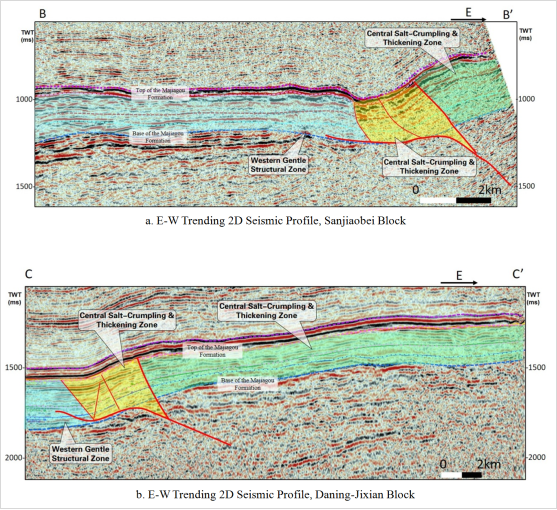
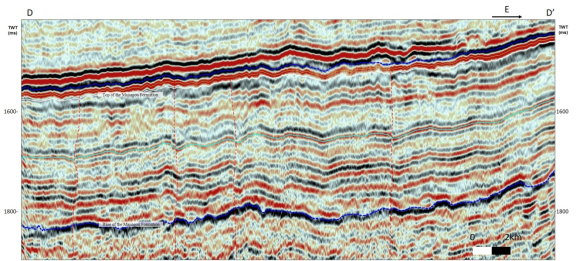
Regional 2D seismic data, despite limitations in resolving intra-Ordovician reflections and fault details, confirm the DTB’s spatial extent extending southward to the Daning-Jixian Block and northward to the Sanjiaobei Block (
Figure 4; see
Figure 1 for locations). North of Sanjiaobei, the belt transitions markedly: plastic deformation within Ordovician salt strata diminishes, the thrust system evolves into steeply dipping (>60°) reverse faults that propagate into shallow sections, and strata east of the faults undergo rapid uplift..
Figure 2. Interpreted Seismic-Geological Profile Along Arbitrary SW-NE Traverse in Shiloubei 3D Survey Area.
Figure 3. Coherence Attribute and Fault System Overlay Map of Ordovician O₁m₃ Member in the Western Shiloubei 3D Survey Area.
Figure 4. Representative 2D Seismic Profiles from the Eastern Ordos Basin Margin.
3.2. Formation and Evolution
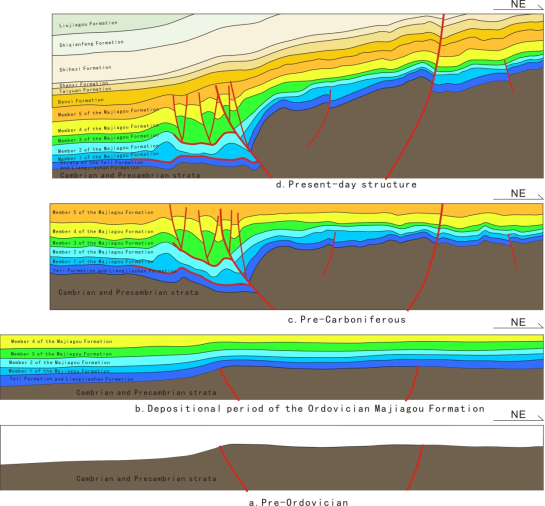
This study employs the balanced section restoration method, selecting a representative SW-NE trending seismic profile from the Shiloubei 3D survey area to analyze tectonic evolution. The results indicate that the eastern Ordos Basin margin has undergone four principal tectonic evolutionary stages since the Early Paleozoic (
Figure 5).
Figure 5. Structural Evolution Profile Along SW-NE Arbitrary Traverse in Shiloubei Block.
3.2.1. Ordovician Epicontinental Sea Stable Sedimentation
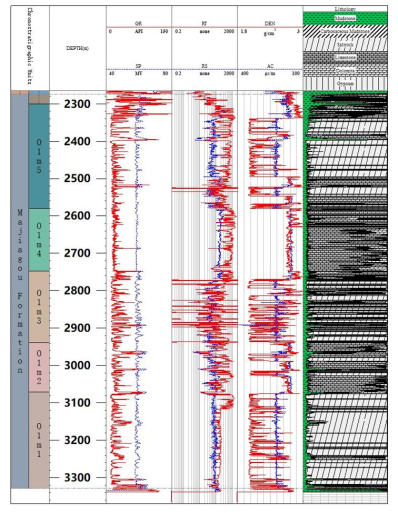
During this period, reduced compressional stress from the Qin-Qi Ocean diminished uplift magnitudes, triggering marine transgression that established a "one uplift flanked by two sags" depositional framework across the Lower Paleozoic Ordos Basin. The Central Paleo-uplift governed the basin-wide east-west sedimentological differentiation during the Ordovician, with the study area situated east of this paleo-high within the North China Sea domain, where an epicontinental sea to large lagoon system developed. Frequent sea-level oscillations generated cyclic successions of carbonates alternating with restricted marine evaporites. Well data confirm alignment with regional depositional patterns in the Majiagou Formation (O₁m): Member O₁m₅ is dominated by interbedded evaporites and carbonates; Members O₁m₄ and O₁m₂ comprise predominantly carbonate sequences; while Members O₁m₁ and O₁m₃ consist primarily of evaporitic units (
Figure 6).
Figure 6. Composite Log Interpretation Column of the Lower Paleozoic Ordovician Majiagou Formation (O₁m) from Well X1, Shiloubei Block.
3.2.2. Late Ordovician - Late Carboniferous DTB Formation Stage
By the Late Ordovician, the Caledonian orogeny fundamentally reconfigured the Ordos Basin's architecture, transforming it from a mosaic of coexisting uplifts and depressions into a unified, regionally extensive uplift. This tectonic reorganization subjected the entire Ordos Block to prolonged erosion, resulting in the absence of Silurian to Lower Carboniferous strata and establishing a 150-Myr depositional hiatus. Post-Caledonian paleotopographic reconstruction reveals that the study area remained topographically lower than the western Otog Banner–Dingbian and Shenmu–Jingbian regions. Within the study area, the Ordovician top unconformity exhibits a parallel unconformable contact with underlying strata (
Figure 2), indicating comparatively limited erosional removal. Consequently, residual sequences including the Majiagou Formation Member M6 and underlying units are preserved.
The Lishi West Detachment Thrust Belt formed during the late Caledonian orogeny. While conventional models attribute this period solely to regional uplift and erosion along the eastern Ordos Basin margin, transpressional tectonic activity in this domain had been rarely documented in prior studies. Crucially, 3D seismic data from the Shiloubei area confirm that the eastern basin margin experienced E-W directed compressional stresses during the Caledonian, which reactivated pre-existing thrust faults and initiated detachment along evaporite layers, ultimately forming the Lishi West Detachment Thrust Belt. West of this thrust belt, localized transpressional strike-slip faults developed within Ordovician strata (
Figure 7; profile locations in
Figures 1 & 8), exhibiting submeridional orientations (
Figure 8).
Figure 7. Seismic-Geological Interpretation Profile of E-W Direction in Eastern Ordos Basin Margin.
Figure 8. Coherence Attribute Map of Ordovician O₁m₄ Member in Well G3 Area.
3.2.3. Late Carboniferous - Middle Jurassic Stable Sedimentation Stage
During the Late Carboniferous to Late Permian, northward subduction of the Paleo-Asian Ocean beneath the northern margin of the North China Plate drove the progressive uplift of the Yinshan Paleoland to the north and the ancient Qinling Orogen to the south. These rising terranes supplied substantial detritus to the Ordos Basin. Along its eastern margin, depositional systems transitioned from early marine lagoonal-tidal flat complexes to continental fluvial-deltaic systems, with sedimentological differentiation shifting from east-west to north-south partitioning. From the Triassic onward, the basin evolved into an intracratonic depression, wherein the Jinxi Warp-Fold Belt persisted as an integral depocenter, accumulating predominantly fluvio-lacustrine terrigenous clastic successions.
3.2.4. Middle Jurassic - Cretaceous Compressional Uplift Stage
Since the Late Jurassic, the combined effects of northward compression from the Paleo-Tethyan tectonic domain and NW-directed subduction of the Pacific Plate initiated uplift of the Lüliang Mountains, imposing intense multidirectional intracontinental compression upon the eastern Ordos Basin. This tectonic regime triggered basin-wide uplift that established the present east-high-west-low structural configuration and concurrently formed the Jinxi Warp-Fold Belt. Within the Shiloubei area, Yanshanian deformation induced eastward tilting and uplift, reactivating the pre-existing thrust fault F2. Post-tectonic characteristics across the Shiloubei Detachment Thrust Belt reveal pronounced contrasts: east of the belt, steeper formation dips (>25°) coincide with NE-NNE trending faults and concentrated compressional structures; west of the belt, gentle structural relief features reduced dips (<10°) with diminished faulting and compressional deformation.
4. Geological Significance and Exploration Potential
Previous studies on the structural characteristics and evolution of the Jinxi Warp-Fold Belt in the eastern Ordos Basin
| [9] | ZHAO Z Y, GUO Y R, WANG Y, et al. Research advances in tectonic evolution and paleogeography of Ordos Basin [J]. Special Oil & Gas Reservoirs, 2012, 19(05): 15-20 and supplementary 151. |
| [10] | YANG H, XI S L, WEI X S, et al. Evolution of polycyclic superimposed basin and natural gas enrichment in Ordos Basin [J]. China Petroleum Exploration, 2006(01): 17-24 and supplementary 6. |
[9, 10]
established that this belt remained part of a major depositional basin prior to the Late Jurassic. Since then, Lüliang Mountain uplift subjected the basin’s eastern margin to intense multidirectional intracontinental compression, driving regional uplift that formed the current east-high-west-low configuration and ultimately shaped the Jinxi Warp-Fold Belt
| [11] | JIANG B, XU J P, ZHU K, et al. Structural-hydrogeological controls on gas accumulation in eastern Ordos Basin [J]. Geological Journal of China Universities, 2012, 18(03): 438-446. https://doi.org/10.16108/j.issn1006-7493.2012.03.030 |
| [12] | ZHAO J F, LIU C Y, MOUNTNEY N, et al. Timing and process of Lüliang Mountain uplift [J]. Science China Earth Sciences, 2015, 45(10): 1427-1438. |
[11, 12]
. Compared to the Yishan Slope, the Jinxi Belt exhibits steeper formation dips and hosts NE-NNE trending compressional structures that diminish westward. While its eastern boundary is clearly defined by the Lishi Fault, its western boundary with the Yishan Slope has remained ambiguous and contentious
| [13] | LIAO C Z, ZHANG Y Q, WEN C S. Structural styles and regional tectonic significance of the boundary belt in eastern Ordos Basin [J]. Acta Geologica Sinica, 2007(04): 466-474. |
| [14] | BAI Y B, SUN D S. Structural characteristics and evolution of Lishi Fault Zone [J]. Oil & Gas Geology, 1996(01): 77-80. |
[13, 14]
.
Integrated interpretation of 3D seismic data (Shiloubei Block) and 2D profiles (Sanjiao/Daji areas) identifies the Lishi West Detachment Thrust Belt (DTB) as a regional-scale (>150km long), submeridionally striking thrust system. Originating as Precambrian basin-bounding faults and consolidating during the Caledonian as a deep-seated structural weak zone, this belt localized stress release during Yanshanian westward compression—triggering regional tilting that generated abrupt contrasts in formation dips and fault densities across the belt, thereby defining the Jinxi Belt-Yishan Slope boundary.
The DTB exerts critical control on hydrocarbon systems:
West of DTB: Low deformation intensity, limited faulting, gentle dips (2-5°), favorable preservation, and deeper burial (>2,000 m) create premier exploration targets for deep coalbed methane (CBM) and in-source/near-source tight gas, evidenced by discoveries like Linxing-Shenfu and Daning-Jixian fields.
East of DTB: Rapid Neogene uplift, shallow Permian coal seams (<1,500 m), extensive Mesozoic erosion (>70%), and intense faulting facilitate hydrocarbon escape, preserving only adsorption-dominated CBM with subcommercial tight gas potential.
For Lower Paleozoic plays:
Post-Caledonian low-topography positioning restricted karst development, yielding poorly developed weathering crust reservoirs with marginal exploration potential.
Within the O₁m Formation, the DTB hosts large-scale (>50km2) anticlinal/fault-anticlinal traps. Their viability hinges on source-reservoir configurations, though the underexplored subsalt/deep domain (penetrated by <10 wells) demands systematic investigation.
5. Conclusions
The Lishi West Detachment Thrust Belt (DTB) constitutes a regionally extensive, submeridionally striking thrust system with a strike length exceeding 150km.
This DTB evolved through four principal stages: Ordovician epicontinental sea sedimentation; Late Ordovician–Late Carboniferous DTB formation; Late Carboniferous–Middle Jurassic stable sedimentation; and Middle Jurassic–Cretaceous compressional uplift.
Originating as a deep-seated structural weak zone during the Caledonian period, the DTB localized stress release during Yanshanian westward compression, which induced regional tilting and generated abrupt contrasts in formation dips and fault densities across the belt. Consequently, it demarcates the boundary between the Jinxi Warp-Fold Belt and Yishan Slope.
The DTB critically controls hydrocarbon accumulation and migration: Areas west of the belt represent premier exploration targets for deep coalbed methane (CBM) and in-source/near-source tight gas due to favorable preservation conditions; A series of large-scale positive structural traps within the Ordovician Majiagou Formation (O₁m) along the belt exhibit significant exploration potential.
Abbreviations
DTB | Detachment Thrust Belt |
Conflicts of Interest
The authors declare no conflicts of interest.
References
| [1] |
XU F Y, HOU W, XIONG X Y, et al. Current status and development strategy of China's coalbed methane industry [J/OL]. Petroleum Exploration and Development: 1-14 (2023-07-20).
|
| [2] |
CAI Y D, GAO G S, LIU D M, et al. Geological conditions and accumulation models of coal-measure gas in Linxing central area, eastern Ordos Basin [J]. Natural Gas Industry, 2022, 42(11): 25-36.
|
| [3] |
YAO H S, CHEN Z L, HE X P, et al. "Effective proppant support" concept and innovative practice in deep CBM development: Case study of Yanchuannan CBM field, Ordos Basin [J]. Natural Gas Industry, 2022, 42(06): 97-106.
|
| [4] |
YANG H, FU J H, WEI X S, et al. Natural gas exploration domains in Ordovician marine carbonates, Ordos Basin [J]. Acta Petrolei Sinica, 2011, 32(05): 733-740.
|
| [5] |
XIE K, TAN X C, FENG M, et al. Early diagenetic karstification and reservoir-controlling effects in Majiagou Formation (Ordovician), eastern Sulige gas field, Ordos Basin [J]. Petroleum Exploration and Development, 2020, 47(06): 1159-1173.
|
| [6] |
WANG Y N, REN J F, YANG W J, et al. Gas accumulation characteristics and exploration potential of Majiagou Formation in central-eastern Ordos Basin [J]. Marine Origin Petroleum Geology, 2015, 20(04): 29-37.
|
| [7] |
HE H Q, GUO X J, ZHAO Z Y, et al. New insights into gas accumulation and major exploration breakthrough in subsalt M4 member of Ordovician, Ordos Basin [J]. Petroleum Exploration and Development, 2022, 49(03): 429-439.
|
| [8] |
FU J H, YU Z, LI C S, et al. New discovery and exploration direction of Ordovician M4 member gas in Well Mitan 1, eastern Ordos Basin [J]. Natural Gas Industry, 2021, 41(12): 17-27.
|
| [9] |
ZHAO Z Y, GUO Y R, WANG Y, et al. Research advances in tectonic evolution and paleogeography of Ordos Basin [J]. Special Oil & Gas Reservoirs, 2012, 19(05): 15-20 and supplementary 151.
|
| [10] |
YANG H, XI S L, WEI X S, et al. Evolution of polycyclic superimposed basin and natural gas enrichment in Ordos Basin [J]. China Petroleum Exploration, 2006(01): 17-24 and supplementary 6.
|
| [11] |
JIANG B, XU J P, ZHU K, et al. Structural-hydrogeological controls on gas accumulation in eastern Ordos Basin [J]. Geological Journal of China Universities, 2012, 18(03): 438-446.
https://doi.org/10.16108/j.issn1006-7493.2012.03.030
|
| [12] |
ZHAO J F, LIU C Y, MOUNTNEY N, et al. Timing and process of Lüliang Mountain uplift [J]. Science China Earth Sciences, 2015, 45(10): 1427-1438.
|
| [13] |
LIAO C Z, ZHANG Y Q, WEN C S. Structural styles and regional tectonic significance of the boundary belt in eastern Ordos Basin [J]. Acta Geologica Sinica, 2007(04): 466-474.
|
| [14] |
BAI Y B, SUN D S. Structural characteristics and evolution of Lishi Fault Zone [J]. Oil & Gas Geology, 1996(01): 77-80.
|
Cite This Article
-
APA Style
Pan, X., Yongzhou, L., Wan, D., Hui, M., Xiaofang, D., et al. (2026). Structural Characteristics and Exploration Significance of the Lower Paleozoic Detachment Thrust Belt in the Eastern Ordos Basin. Earth Sciences, 15(1), 1-9. https://doi.org/10.11648/j.earth.20261501.11
 Copy
|
Copy
|
 Download
ACS Style
Pan, X.; Yongzhou, L.; Wan, D.; Hui, M.; Xiaofang, D., et al. Structural Characteristics and Exploration Significance of the Lower Paleozoic Detachment Thrust Belt in the Eastern Ordos Basin. Earth Sci. 2026, 15(1), 1-9. doi: 10.11648/j.earth.20261501.11
Copy
|
Download
AMA Style
Pan X, Yongzhou L, Wan D, Hui M, Xiaofang D, et al. Structural Characteristics and Exploration Significance of the Lower Paleozoic Detachment Thrust Belt in the Eastern Ordos Basin. Earth Sci. 2026;15(1):1-9. doi: 10.11648/j.earth.20261501.11
Copy
|
Download
-
@article{10.11648/j.earth.20261501.11,
  author = {Xu Pan and Li Yongzhou and Diao Wan and Ma Hui and Du Xiaofang and Yin Xiaohe},
  title = {Structural Characteristics and Exploration Significance of the Lower Paleozoic Detachment Thrust Belt in the Eastern Ordos Basin},
  journal = {Earth Sciences},
  volume = {15},
  number = {1},
  pages = {1-9},
  doi = {10.11648/j.earth.20261501.11},
  url = {https://doi.org/10.11648/j.earth.20261501.11},
  eprint = {https://article.sciencepublishinggroup.com/pdf/10.11648.j.earth.20261501.11},
  abstract = {Utilizing 2D and 3D seismic data, a large-scale detachment thrust structure within the Lower Paleozoic Ordovician Majiagou Formation (O1m) has been identified west of Lishi in the eastern Ordos Basin. This study investigates the structural characteristics, spatial distribution, evolutionary stages, and exploration potential of this structure. The results indicate: (1) The Lower Paleozoic Lishi West Detachment Thrust Belt (DTB) in the eastern Ordos Basin margin is 5–10km wide, extends nearly north-south parallel to the Lishi Fault Zone, and has considerable strike length. (2) The main faults of the Lishi West DTB initiated in the Precambrian and subsequently underwent four major evolutionary stages: stable sedimentation in the Ordovician epicontinental sea; formation of the detachment thrust belt from the Late Ordovician to Late Carboniferous; stable sedimentation from the Late Carboniferous to Middle Jurassic; and compressional uplift from the Middle Jurassic to Cretaceous. (3) The Lishi West DTB originated during the Caledonian period as a deep-seated structural weak zone. During the Yanshanian period, the eastern basin margin experienced westward compression, leading to regional tilting and uplift. Stress release along this pre-existing weak zone caused significant variations in formation dip angles and fault characteristics across the belt. This DTB is interpreted as the boundary separating the Jinxi Warp-Fold Belt and the Yishan Slope. (4) The detachment thrust belt in the eastern margin plays a critical role in hydrocarbon accumulation and subsequent migration/readjustment. The area west of the belt is favorable for exploring various coal-measure hydrocarbon resources, including deep coalbed methane (CBM) and in-source to near-source tight gas. A series of positive structural traps with large aerial extent have developed within the O1m Formation along the Lishi West DTB, demonstrating high exploration potential.},
 year = {2026}
}
Copy
|
Download
-
TY  - JOUR
T1  - Structural Characteristics and Exploration Significance of the Lower Paleozoic Detachment Thrust Belt in the Eastern Ordos Basin
AU  - Xu Pan
AU  - Li Yongzhou
AU  - Diao Wan
AU  - Ma Hui
AU  - Du Xiaofang
AU  - Yin Xiaohe
Y1  - 2026/01/23
PY  - 2026
N1  - https://doi.org/10.11648/j.earth.20261501.11
DO  - 10.11648/j.earth.20261501.11
T2  - Earth Sciences
JF  - Earth Sciences
JO  - Earth Sciences
SP  - 1
EP  - 9
PB  - Science Publishing Group
SN  - 2328-5982
UR  - https://doi.org/10.11648/j.earth.20261501.11
AB  - Utilizing 2D and 3D seismic data, a large-scale detachment thrust structure within the Lower Paleozoic Ordovician Majiagou Formation (O1m) has been identified west of Lishi in the eastern Ordos Basin. This study investigates the structural characteristics, spatial distribution, evolutionary stages, and exploration potential of this structure. The results indicate: (1) The Lower Paleozoic Lishi West Detachment Thrust Belt (DTB) in the eastern Ordos Basin margin is 5–10km wide, extends nearly north-south parallel to the Lishi Fault Zone, and has considerable strike length. (2) The main faults of the Lishi West DTB initiated in the Precambrian and subsequently underwent four major evolutionary stages: stable sedimentation in the Ordovician epicontinental sea; formation of the detachment thrust belt from the Late Ordovician to Late Carboniferous; stable sedimentation from the Late Carboniferous to Middle Jurassic; and compressional uplift from the Middle Jurassic to Cretaceous. (3) The Lishi West DTB originated during the Caledonian period as a deep-seated structural weak zone. During the Yanshanian period, the eastern basin margin experienced westward compression, leading to regional tilting and uplift. Stress release along this pre-existing weak zone caused significant variations in formation dip angles and fault characteristics across the belt. This DTB is interpreted as the boundary separating the Jinxi Warp-Fold Belt and the Yishan Slope. (4) The detachment thrust belt in the eastern margin plays a critical role in hydrocarbon accumulation and subsequent migration/readjustment. The area west of the belt is favorable for exploring various coal-measure hydrocarbon resources, including deep coalbed methane (CBM) and in-source to near-source tight gas. A series of positive structural traps with large aerial extent have developed within the O1m Formation along the Lishi West DTB, demonstrating high exploration potential.
VL  - 15
IS  - 1
ER  -
Copy
|
Download





 Share This Article
 Twitter
 Linked In
 Facebook